Introduction
Xenon is one of the rarest stable gases on Earth — and right now, demand is accelerating from space propulsion, semiconductor manufacturing, and medical imaging all at once. For procurement managers and lab directors who depend on consistent supply, that convergence isn't an abstraction. It's showing up as longer lead times, tighter allocations, and in some cases, no supply at all.
Unlike commodity gases, xenon cannot be produced on demand. It exists only as a by-product of large-scale cryogenic air separation, where oxygen production drives the entire process. Global output is directly tied to the pace of heavy industry — steelworks, chemical plants, and other oxygen-intensive operations.
Supply expansion is slow, capital-intensive, and geographically concentrated. When demand outpaces that pace, there's no quick fix.
What follows is a practical look at what's driving the current xenon market, where supply bottlenecks are forming, and what procurement managers and industrial gas buyers can do to stay ahead of shortages.
Key Takeaways
- Xenon is extracted only as a by-product of cryogenic air separation, making supply expansion slow and capital-intensive
- Russia-Ukraine conflict continues to strain Western xenon supply chains, which historically depended on the region for nearly half of Europe's rare gas imports
- Demand is rising simultaneously from satellite propulsion, semiconductor fabs, and medical imaging, intensifying competition for limited supply
- Substitution options are narrow—most high-value applications have no viable alternative that matches xenon's performance
- Long-term supply agreements with qualified specialty gas providers outperform spot-market procurement in both cost and reliability
The Xenon Supply Crunch: What's Causing It
Atmospheric Scarcity Sets the Baseline Constraint
Xenon constitutes only approximately 0.087 parts per million of Earth's atmosphere—the lowest concentration of any stable noble gas. This atmospheric rarity is the foundational constraint on all supply. To produce just 1 cubic meter (5.9 kg) of pure xenon, more than 10 million cubic meters of air must be processed—roughly 12,920 tonnes of air for every cubic meter of xenon recovered.
Extraction Requires Massive Infrastructure
Xenon recovery is exclusively a function of cryogenic distillation in very large air separation units (ASUs). Only facilities producing more than 1,000 tonnes of oxygen per day can economically extract xenon. These plants are typically co-located with steelworks or large chemical plants, meaning global xenon output is tied to specific regions and industries—and cannot be rapidly scaled.
During fractional distillation of liquefied air, oxygen and nitrogen are the primary products. Xenon and krypton are captured together in the final, most energy-intensive stages.
Krypton yields run roughly ten times higher than xenon yields from the same feedstock. About 90% of pure xenon comes from crude krypton-xenon gas mixtures that require additional purification steps before reaching usable purity.
Supply Expansion Takes Years, Not Months
Adding xenon capture capability to an existing ASU that does not currently produce it takes an estimated one to three years—one year to identify a suitable project and two years for construction and certification. This means supply responses to market tightness are inherently slow, and buyers cannot count on rapid capacity additions to relieve pricing pressure.
Why Oxygen Demand Controls Xenon Supply
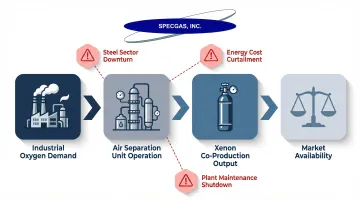
Because xenon output is tied to oxygen production rather than xenon demand itself, any slowdown in oxygen-consuming industries directly reduces xenon availability. Common triggers include:
- Steel sector downturns cutting oxygen consumption at co-located ASUs
- Scheduled or emergency plant maintenance reducing operational throughput
- Energy cost pressures forcing curtailment of energy-intensive distillation stages
This co-production structure makes xenon uniquely exposed to industrial cycles that have nothing to do with xenon demand itself.
Rising Demand: Who's Competing for Xenon Right Now
Space Propulsion
Xenon is the propellant of choice for electric ion thrusters used in satellites for station-keeping, orbital maneuvering, and deep-space missions. Its high atomic mass, low ionization energy, and chemical inertness generate efficient thrust while remaining safe to store. The commercial satellite industry set records in 2024 with 259 launches deploying 2,695 satellites, and electric propulsion has historically represented about 10% of the xenon market—a share expanding rapidly as LEO constellations proliferate.
Semiconductor Manufacturing
Xenon and krypton are critical for excimer lasers used in high-aspect-ratio etching processes in advanced memory manufacturing, particularly 3D NAND flash. As layer stacking strategies intensify to pack more storage density into chips, xenon demand from chipmakers is expected to rise substantially. Any purity specification failure in this context can mean costly production losses, making semiconductor-grade xenon (5N to 6N purity) a non-negotiable requirement.
Medical Imaging and Healthcare
Following the FDA's 2022 approval of Polarean's XENOVIEW (hyperpolarized xenon Xe 129) as the first inhaled MRI contrast agent, and its 2025 expansion to pediatric patients aged 6 and older, xenon's medical role is moving from research into active clinical use.
Institutions like UVA Health have entered supply agreements with Polarean and secured $7.4 million in NIH grants to evaluate lung transplant rejection and e-cigarette lung damage using hyperpolarized xenon MRI. That kind of institutional commitment creates sustained, price-inelastic demand — the kind that doesn't pull back when markets soften.
Traditional Applications Remain "Sticky"
While high-intensity xenon arc lamps in cinema projectors and automotive headlamps have partially declined due to LED adoption, xenon remains irreplaceable in applications requiring UV output, intensity, or color rendering — such as solar simulators and medical dermatological lasers. Demand in these traditional segments holds steady even as newer applications layer on top.
The Cumulative Effect
Multiple high-growth sectors are simultaneously drawing from a supply base that has not materially expanded. Space, semiconductors, and healthcare aren't taking turns — they're competing at the same time, against the same constrained production capacity. That's what makes the current tightening structural rather than seasonal.
Geopolitical Disruptions Reshaping the Supply Chain
Russia's Historical Role
Russia has been one of the largest xenon exporters globally, thanks to its extensive air separation infrastructure built around steel production. International sanctions and geopolitical isolation have introduced ongoing volatility into supply flows that Western buyers previously took for granted.
Ukraine's Critical Purification Capacity—Now Offline
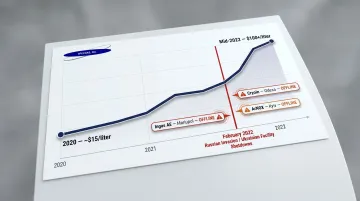
Ukraine historically played a critical role in the rare gas supply chain. Facilities such as Ingas AE in Mariupol, Cryoin Engineering Ltd in Odesa, and ArNOX in Kyiv processed crude rare gases from Russian steel plants and purified them for semiconductor-grade export.
Following the Russian invasion in February 2022, these facilities halted operations or were destroyed, instantly removing a massive portion of global supply. The price response was immediate: wholesale xenon spiked from approximately $15 per liter in 2020 to over $100 per liter by mid-2022.
Europe's Import Dependency
The EU sourced approximately 47% of its rare gas imports from Russia and Ukraine in 2021. This dependency has forced European buyers and policymakers to accelerate diversification toward US, Chinese, and domestic EU sources—including evaluating air separation units (ASUs) that are currently not producing rare gases.
Qualification Delays Compound Supply Challenges
Certifying a new rare gas source for purity and quality—particularly for semiconductor-grade xenon—can take many months or more than a year. Even when alternative supply exists geographically, it may not be immediately usable by regulated end-users.
For procurement teams, that timeline has a direct consequence: buyers who begin qualification only after a disruption hits will face months without a compliant source. Qualifying backup suppliers before a crisis is the only reliable hedge.
New Xenon Applications Adding Market Pressure
Emerging Medical Applications
Hyperpolarized xenon MRI is expanding beyond research into clinical pulmonary diagnostics. FDA approvals and institutional supply agreements are accelerating adoption, and this segment shows price-inelastic demand characteristics — procurement doesn't slow when prices rise. That dynamic makes clinical MRI one of the more structurally durable sources of new xenon consumption.
Dark Matter and Quantum Research
Liquid xenon is the detection medium of choice in particle physics experiments — dark matter searches, neutrino studies — due to its density, scintillation yield, and attainable purity levels. Volumes per experiment are relatively small, but this segment competes directly for ultra-high-purity xenon, the same specification tier demanded by semiconductor and medical buyers.
Semiconductor Lithography Evolution
As chip manufacturers push toward finer feature sizes, xenon consumption per unit of output increases. Excimer laser systems and ion implantation steps both draw on xenon supply, and the continued buildout of EUV and DUV lithography capacity is amplifying that pressure across the noble gas market.
Taken together, these three application areas share a common thread:
- Each requires xenon at ultra-high purity grades
- Each is expanding on its own demand curve, independent of the others
- None is a discretionary purchase — procurement continues regardless of spot price
- All three compete for the same constrained global supply
What Buyers and Procurement Teams Should Do Now
Shift from Spot Purchasing to Long-Term Supply Agreements
Xenon's small market size makes it acutely vulnerable to sharp price spikes during supply disruptions. Buyers who rely on spot purchases are exposed to sudden unavailability and price volatility. Those with qualified, contracted supply relationships are far more insulated. Buyers who locked in contracted volumes before the 2022 disruptions avoided the scramble — those who didn't faced both shortages and inflated spot prices simultaneously.
Explore Recycling and Recovery Options
Secondary xenon supply through recovery from excimer laser systems, anesthetic circuits, and ion thruster systems is technically possible:
- Semiconductor fabs using VPSA can recover 99.9% pure xenon at $554–$1,482/kg — viable for high-volume operations
- Excimer laser point-of-use systems achieve >90% recovery rates, reducing dependence on primary supply
- Anesthesia scavenging via off-line cryogenic cooling recovers 67%–85% of xenon at 89%–95%+ purity
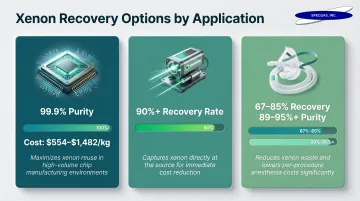
Buyers in high-consumption applications should investigate whether on-site recovery systems can reduce their exposure to primary supply constraints.
Work with Specialty Gas Suppliers Who Can Deliver When Commodity Suppliers Cannot
On-site recovery won't be practical for every operation. For buyers who depend on purchased supply, the differentiator is access to a specialty gas supplier capable of fulfilling high-purity, NIST-traceable xenon and xenon-containing mixtures — including unusual specifications — when large commodity distributors cannot.
SpecGas Inc. blends xenon-containing specialty gases in-house at its Bridgeport, PA facility, including:
- Excimer laser gas formulations with precise xenon concentrations
- Rare gas blends such as 70% Krypton / 30% Xenon
- Low-ppm and low-ppb precision mixtures for calibration and analytical applications
- NIST-traceable standards in both refillable and disposable cylinders
Because every mixture is blended on-site rather than sourced externally, SpecGas can turn orders faster than distributors dependent on bulk commodity allocations — a meaningful advantage when spot availability tightens and standard suppliers go on backorder.
Frequently Asked Questions
How is xenon produced commercially?
Xenon is produced exclusively as a by-product of cryogenic air separation (fractional distillation of liquefied air) in very large air separation units. It is captured in the final, most energy-intensive stages alongside krypton, then purified to the grade required by the end-use application.
How much xenon is in the world?
Xenon is the least abundant stable noble gas in the atmosphere at approximately 0.087 parts per million by volume. Total global annual production is estimated at around 53,000 kg—a tiny fraction compared to oxygen, nitrogen, or argon production volumes.
Why is xenon so expensive compared to other noble gases?
Xenon's high cost comes down to extreme atmospheric rarity and an energy-intensive multi-stage extraction process. Output is also tightly coupled to industrial oxygen demand—not xenon demand—so producers can't simply ramp up supply when prices rise.
Which industries are most vulnerable to xenon supply shortages?
Three sectors face the greatest exposure:
- Semiconductor manufacturers relying on excimer laser etching
- Satellite and spacecraft operators using xenon ion propulsion
- Medical institutions running xenon anesthesia or hyperpolarized MRI
Demand across all three is relatively price-inelastic, and substitution options are limited.
Can xenon be recycled or recovered from industrial processes?
Recovery systems exist for excimer lasers, anesthetic circuits, and ion thrusters, but large-scale infrastructure remains limited. As supply tightens and prices rise, investment in on-site recovery is becoming a practical way to cut costs and reduce exposure to future shortages.