Introduction
When iron powder and sulfur are heated together, they undergo an exothermic chemical reaction that produces iron(II) sulfide (FeS) — a compound with properties entirely different from either starting element.
Understanding why the reaction works is just as important as following the steps. It illustrates the fundamental difference between a physical mixture and a chemical compound, demonstrates how exothermic reactions can become self-sustaining, and shows why chemical change cannot be undone by simple physical means.
This guide covers the underlying chemistry, experimental procedure, common errors, and how iron sulfide connects to real-world applications — including why H₂S gas detection requires precisely calibrated reference standards to be reliable.
Key Takeaways
- Fe + S → FeS: heating iron and sulfur triggers an exothermic reaction that permanently forms iron(II) sulfide
- The correct mass ratio is 7 parts iron to 4 parts sulfur — excess of either element remains unreacted
- Unlike a physical mixture, FeS cannot be separated back into its elements with a magnet
- An orange self-propagating glow signals the reaction is underway; remove the heat source once it appears
- Safety: sulfur ignition releases toxic SO₂ gas — always work in a fume cupboard or well-ventilated area
What Is the Iron and Sulfur Reaction?
The iron and sulfur reaction is a synthesis reaction: iron (Fe) and sulfur (S) combine under heat to form the ionic compound iron(II) sulfide (FeS), represented by the balanced equation Fe + S → FeS.
According to RSC Education's class experiment guidance, the product contains equal numbers of iron and sulfur atoms that are chemically joined — not simply blended. The result is a black or dark grey solid that is insoluble in water and non-magnetic, properties that iron and sulfur don't have on their own.
Mixture vs. Compound — The Core Teaching Point
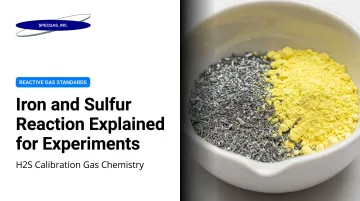
The mixture-vs-compound distinction is exactly why this experiment anchors introductory chemistry curricula. Before heating:
- Iron filings remain magnetic and visibly grey
- Sulfur remains yellow and powdery
- A magnet can physically pull iron out of the mixture
- No chemical bonds exist between the two elements
After the reaction, none of that holds. The product is a single compound — non-magnetic, black, and chemically inseparable — with fixed composition and properties belonging to neither starting material.
How the Iron and Sulfur Reaction Works
The Chemistry
Iron atoms donate electrons to sulfur atoms, forming ionic bonds that create the FeS lattice. This bond formation releases energy as heat and light, making the reaction exothermic. NIST data records the standard enthalpy of formation for solid FeS at −101.67 kJ/mol, confirming the energy released as the ionic lattice forms.
The stoichiometry is straightforward: one mole of iron reacts with one mole of sulfur. Using NIST atomic weights (Fe: 55.845, S: ~32.06), the correct mass ratio works out to approximately 7:4 (iron:sulfur) — which is why RSC's procedure calls for exactly 7 g iron to 4 g sulfur.
Why It Becomes Self-Sustaining
That same energy release is what drives self-sustaining behavior. Once a minimum activation energy is supplied by heating, the reaction releases enough heat to carry itself through the remaining mixture. No continued heating is needed; the exothermic process takes over.
Observable signs of this during the reaction:
- An orange glowing front that moves through the tube after the heat source is removed
- A color change from yellow-grey mixture to black/dark grey solid
- Loss of magnetic response in the finished product
The self-sustaining nature is also why you must stop heating immediately once the glow appears. Continued heating risks igniting unreacted sulfur, which burns to form SO₂ via S + O₂ → SO₂.
How to Set Up the Iron and Sulfur Experiment
This section walks through everything needed to run the experiment safely and get clean, observable results.
Materials Needed
- Iron powder (not coarse iron filings — particle size matters)
- Finely powdered sulfur (flowers of sulfur, or roll sulfur ground with a pestle and mortar)
- Borosilicate (Pyrex) glass test tube or 75 mm × 10 mm ignition tubes
- Bunsen burner
- Mineral wool plug
- Clamp stand and heat-resistant mat
- Safety glasses
- Small bar magnet (for pre-reaction demonstration)
Preparation and Procedure
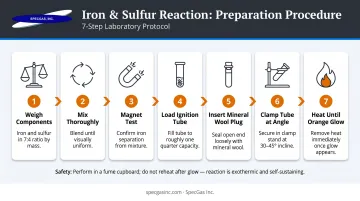
- Weigh out iron powder and sulfur in a 7:4 mass ratio (for example, 3.5 g iron to 2 g sulfur for a small batch)
- Mix thoroughly by transferring between containers until the powder appears homogeneous
- Perform the magnet test on the mixture — iron should still separate cleanly, confirming it remains a physical mixture
- Load the ignition tube no more than one-quarter full with the mixture (RSC specifies 0.2 g is sufficient to observe the effect)
- Insert a mineral wool plug at the mouth of the tube to prevent sulfur vapor escaping and catching fire, per CLEAPSS guidance
- Clamp the tube securely at an angle over a heat-resistant mat
- Heat at the base with a Bunsen burner until the orange glow appears, then remove the heat source immediately
Observation and Verification
During the reaction, watch for the self-propagating glow moving upward through the tube. After cooling:
- The solid should appear black or dark grey
- Apply the magnet test again — the product should show little to no magnetic attraction
- RSC notes the non-magnetic result is not always conclusive and recommends using a very weak magnet for this test
- Inconsistent results are normal — they do not indicate experimental failure
Key Factors That Affect the Reaction
Mass Ratio
The 7:4 iron-to-sulfur mass ratio is stoichiometrically correct for complete reaction. Any deviation leaves excess reactant behind:
- Too much iron: unreacted iron remains alongside FeS, making the post-reaction magnet test misleading
- Too much sulfur: excess sulfur may ignite during heating, releasing SO₂
Particle Size and Mixing
Finer particles mean greater surface area, which increases contact between iron and sulfur atoms and improves reaction consistency. RSC specifies iron powder (not coarse filings) for this reason. Uneven mixing can produce patchy reactions or unreacted zones in the tube — check mixing uniformity first if results look inconsistent.
Once the mixture is prepared, heat application and ventilation become the two remaining variables that determine whether the reaction proceeds safely.
Heat Source and Ventilation
| Factor | Risk if Too Low | Risk if Too High |
|---|---|---|
| Heat intensity | Reaction fails to initiate | Sulfur ignites, releases SO₂ |
| Ventilation | SO₂ accumulates | N/A |
Per NIOSH, SO₂ has an IDLH of 100 ppm, with an OSHA PEL of 5 ppm TWA. Always work in a fume cupboard or well-ventilated space regardless of whether problems appear likely.
Common Issues and Misconceptions
Three misconceptions come up consistently when students run this experiment. Recognizing them in advance prevents confusion and avoids real safety risks.
"The Mixture Is Already a Compound"
A blend of iron and sulfur is still a physical mixture until heat is applied. The yellow sulfur is visible, iron still responds to a magnet, and no bonds have formed. Chemical combination requires energy input — the mixing alone changes nothing.
Continuing to Heat After the Glow Appears
Once the orange glow begins, the reaction is self-sustaining. Additional heat serves no purpose and introduces real risk. RSC's instructions are explicit: stop heating when the glow is visible. Continuing can ignite excess sulfur, generate SO₂, and crack the glassware.
Expecting Iron Sulfide to Be Magnetic
Because iron is magnetic, many students predict the product will behave the same way. It won't. FeS has very low magnetic response compared to iron metal, so variable magnet test results after the reaction are normal and expected, not a sign the experiment failed.
Real-World Applications of Iron Sulfide
Natural and Biological Occurrences
Iron sulfide forms naturally wherever oxygen is scarce and sulfate-reducing bacteria are active. A 2023 peer-reviewed review confirms that FeS is the first iron sulfide species formed by sulfate-reducing bacteria under anoxic conditions — a process occurring in swamp sediments, ocean dead zones, and lake beds.
On a smaller scale, the ACS notes that iron and sulfide in egg yolks can combine to form iron(II) sulfide, which explains the green discoloration around the yolk in century eggs.
Industrial Relevance and H₂S Safety
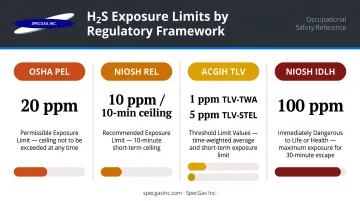
When FeS contacts acids, hydrogen sulfide (H₂S) gas is released — a reaction used in laboratory settings to generate H₂S on demand. H₂S is toxic at low concentrations, with regulatory exposure limits set across multiple frameworks:
- OSHA PEL: 20 ppm ceiling (not to be exceeded during an 8-hour shift)
- NIOSH REL: 10 ppm ceiling for 10 minutes
- ACGIH TLV-TWA: 1 ppm; TLV-STEL: 5 ppm
- NIOSH IDLH: 100 ppm
Industrial and laboratory facilities that work with H₂S — including oil and gas processing, wastewater treatment, and petrochemical refining — rely on accurately calibrated gas detection equipment to maintain safe exposure levels.
Calibration Gas Standards for H₂S Monitoring
Detector accuracy depends entirely on the reference standard used to calibrate it. SpecGas Inc. is a Pennsylvania-based specialty gas manufacturer with roots in German R&D dating to 1976.
Their NIST-traceable H₂S calibration gas mixtures cover 300 ppb up to 10% concentration, spanning the full range needed for electrochemical sensor calibration across occupational safety, wastewater, and petrochemical applications. Key features of their H₂S calibration gas line include:
- Concentration range from 300 ppb to 10% — suitable for trace-level and high-concentration detector calibration
- Proprietary cylinder treatment process that stabilizes reactive H₂S and extends shelf life
- Maintained concentration accuracy, reducing the risk of calibration drift and missed exposure alarms
- Multi-component mixtures combining H₂S with SO₂, CO, and other gases for sour gas environments
Conclusion
The iron and sulfur reaction does something deceptively simple: it converts two recognizable elements into a completely different substance that cannot be taken apart again by physical means. The product — iron sulfide — has a formula, appearance, and behavior entirely unlike either starting material, none of which you could anticipate from the elements alone.
For students, this anchors the distinction between mixtures and compounds in a way that a textbook definition never quite manages. For lab professionals, it reinforces why stoichiometry, particle preparation, and ventilation controls matter: each one reflects something real about how the chemistry behaves, not just how a protocol is written.
Getting the ratio right, using fine powder, stopping the heat at the first glow, and working in ventilated conditions: these aren't just steps to follow. They reflect the underlying chemistry. Understanding why each step exists is what turns a straightforward demonstration into genuine chemical reasoning.
Frequently Asked Questions
What happens if you mix sulfur and iron?
Mixing the two creates a physical mixture — not a compound. Each element keeps its own properties: the iron responds to a magnet, and the yellow sulfur remains visible. Only when heat is applied does a chemical reaction occur, forming iron(II) sulfide.
What is iron sulfide used for?
In laboratory settings, it's used to generate hydrogen sulfide gas by reacting with acids. Iron sulfide also appears in environmental and geochemical research related to sulfur cycling in low-oxygen environments, and occurs naturally in anoxic sediments and biological systems.
Is the iron and sulfur reaction reversible?
No — once FeS forms, iron and sulfur cannot be separated by physical means such as a magnet. Reversing the reaction would require a chemical process, making it irreversible under standard lab conditions.
What safety precautions are needed for the iron and sulfur experiment?
Eye protection and adequate ventilation (ideally a fume cupboard) are essential. Use borosilicate glassware with a mineral wool plug to contain sulfur vapor. Remove the heat source immediately once the orange glow appears to prevent sulfur ignition and SO₂ release.
What is the correct ratio of iron to sulfur for the experiment?
The stoichiometrically correct ratio is 7 parts iron to 4 parts sulfur by mass (for example, 3.5 g iron to 2 g sulfur). This allows both elements to react fully; any excess of either will remain unreacted alongside the iron sulfide product.
How is iron sulfide different from iron pyrite?
Pyrite (FeS₂) contains a different iron-to-sulfur ratio than iron(II) sulfide (FeS), has a cubic crystal structure, and is significantly more stable — peer-reviewed thermodynamic research confirms FeS phases are metastable intermediates relative to pyrite. Lab-produced FeS is a soft, black, non-crystalline solid; pyrite is a hard, pale yellow mineral.