Introduction
A gas analyzer is only as accurate as the calibration gas used to verify it. Every gas analyzer, detector, and continuous emissions monitoring system (CEMS) relies on calibration gas to establish the baseline between what the instrument measures and what it reports — and even small errors in that baseline compound across every reading that follows.
Selecting the wrong calibration gas — or misunderstanding the differences between types — can produce skewed readings, failed audits, and regulatory violations. For emissions monitoring programs subject to regulatory oversight, the calibration gas specification is part of the compliance record, not just a lab preference.
This article covers the main calibration gas types used in air quality analysis — from single-component standards to multi-component CEMS blends — along with what drives the choice between them.
Key Takeaways
- Calibration gas is a precisely blended reference mixture used to set and verify the accuracy of air quality monitoring instruments
- Zero gas establishes baseline readings; span gas verifies instrument response at known concentrations
- Complexity ranges from single-component to multi-component blends; certification grades include NIST-traceable and other certified reference standards
- Selection depends on target pollutants, regulatory requirements, and accuracy needed
- Using the wrong gas type or certification grade can invalidate monitoring data and cause regulatory non-compliance
What Is Calibration Gas for Air Quality Analysis?
Calibration gas is a precisely prepared gas mixture of known composition used to adjust and verify the response of gas analyzers, detectors, and continuous emissions monitoring systems (CEMS).
In air quality analysis, these mixtures contain pollutant compounds such as carbon monoxide (CO), nitrogen oxides (NOx), sulfur dioxide (SO2), ozone precursors, or volatile organic compounds (VOCs)—balanced in nitrogen or clean air at concentrations that reflect real-world measurement ranges.
Without calibration gas, an instrument has no verified relationship between its output signal and the actual concentration of the gas it's measuring. It may respond when exposed to a pollutant, but whether that response corresponds to 10 ppm or 100 ppm is impossible to verify without a reference standard.
That reference standard lets operators confirm the instrument reads correctly across its full operating range and correct any discrepancies before errors reach reported data.
Why Calibration Gas Matters in Air Quality Analysis
Air quality instruments drift over time. Sensor aging, temperature changes, and exposure to sample gases all degrade performance. Research shows electrochemical sensors can shift 2-5% per month due to chemical degradation and environmental factors. Calibration gas is the mechanism used to detect and correct that drift before it affects reported data.
Without proper calibration, instruments report false readings — overstating or understating pollutant concentrations, producing incorrect compliance reports, and missing exceedances entirely. The consequences extend beyond data quality: using expired calibration gas or failing calibration audits immediately invalidates emissions data.
Facilities that fail validation are forced into punitive missing data substitution procedures under 40 CFR 75 Subpart D, which typically assume worst-case emissions values for the affected period.
Most regulated emissions monitoring programs require documented calibration with certified reference gases as a condition of data validity. Key regulatory requirements include:
- 40 CFR Part 60 Appendix F: mandates daily calibration drift checks for continuous emissions monitoring systems
- 40 CFR Part 75: requires calibration error tests at both zero-level and high-level concentrations, with allowable deviations no greater than 2.5% of instrument span
Selecting the right calibration gas — at the correct concentration, certified to traceable standards — is a condition of data validity, not an optional quality step.
Types of Calibration Gas for Air Quality Analysis
Calibration gas is not a single product category. It exists in distinct types that differ by function, composition, and certification level. The correct choice depends on the role the gas plays in the calibration procedure.
Zero Calibration Gas
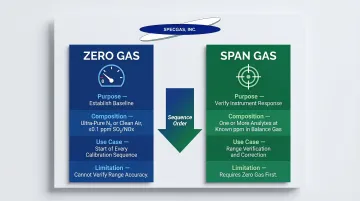
Zero gas is a pure gas—not a mixture—that is either completely free of the target component or contains less than a defined threshold concentration of it. Common examples include ultra-pure nitrogen, synthetic clean air, or CO2/CH4-free air. When synthetic clean air is used as Zero Air, it is a mixture of 79% Nitrogen and 21% Oxygen, produced by blending these pure components. It establishes a baseline "zero" reading on an analyzer before introducing a known concentration.
Unlike span gas, zero gas doesn't test sensitivity across a range. It only confirms the analyzer reads zero when no target pollutant is present—removing cross-sensitivity or sensor offset before any further calibration steps.
Zero gas is used at the start of every calibration sequence. It's essential in CEMS applications, combustion analyzer checks, and ambient air monitoring setups where a verified baseline is required before span calibration. 40 CFR 72.2 defines zero air material as containing ≤ 0.1 ppm of SO2, NOx, or total hydrocarbons, ≤ 1 ppm CO, and ≤ 400 ppm CO2.
Strengths and limitations:
- Simple to specify and source
- Excellent long-term stability, especially inert zero gases like nitrogen
- Mandatory component of any multi-point calibration procedure
- Cannot verify instrument accuracy across its full range—span gas must always follow
Single-Component Span Gas
Single-component span gas is a calibration mixture containing one target pollutant at a precisely known concentration in a balance gas (typically nitrogen or clean air). It verifies and adjusts the instrument's response at a specific point in its measurement range.
Where zero gas establishes a baseline, span gas introduces a known quantity of the analyte—for example, 50 ppm CO or 18 ppm NOx—so the instrument's reading can be compared against the certified value and corrected if there's a discrepancy.
This is the standard choice for routine checks on sources that emit one primary pollutant, such as a natural gas boiler monitored for CO, and for response checks required under combustion performance monitoring procedures. Single-component gases are straightforward to specify, certify, and troubleshoot. If an instrument fails to read correctly, the source of the problem is clear.
The tradeoff: they're not efficient when you need to verify instrument response to multiple pollutants simultaneously. That's where multi-component blends become necessary.
Multi-Component Calibration Gas Mixtures
Multi-component blends are calibration gas cylinders containing two or more target pollutants at certified concentrations in a single cylinder—for example, NOx + CO + SO2 in a nitrogen or air balance. They calibrate instruments that monitor several analytes at once.
Rather than switching between multiple single-gas cylinders, a single multi-component cylinder calibrates multiple measurement channels in one step. The tradeoff is complexity: blending and certifying these mixtures is significantly more demanding due to component interactions and reactive gas stability challenges.
Common applications:
- CEMS monitoring at industrial facilities
- Environmental monitoring networks
- Emissions testing where NOx, CO, SO2, and O2 are all calibrated in the same monitoring event
- Research labs tracking multiple criteria pollutants simultaneously
The practical advantages are real—reduced cylinder inventory, faster calibration sequences, and lower handling costs. In many regulatory applications, two cylinders can cover most combustion source monitoring requirements.
The critical limitation is stability. Reactive components such as NO or SO2 can degrade over time through wall reactions or interaction with other blend constituents. Established calibration gas stability guidelines define maximum certification periods: SO2 in nitrogen (1–50 ppm) carries a 4-year shelf life, while NO in oxygen-free nitrogen (0.5–50 ppm) is rated for 3 years—but only when filled in passivated aluminum cylinders. Suppliers must provide documented stability data to support those claims.
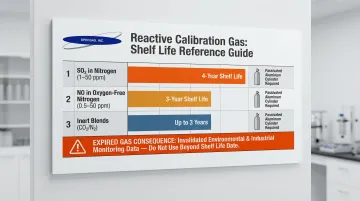
SpecGas's proprietary internal cylinder treatment process is designed specifically for reactive gas stability, including enhanced shelf life for mixtures with corrosive components, with documented stability data available to support compliance requirements.
Certified Reference Gases and NIST-Traceable Standards
This category includes calibration gas manufactured and analytically certified to meet specific regulatory traceability requirements—NIST-traceable reference materials certified gravimetrically against national standards, providing the documented chain of measurement traceability required for regulated applications.
What separates these gases from the other types is not just composition—it's the documented chain of measurement traceability. Certification must demonstrate that the stated concentration was verified against primary standards with an analytical uncertainty (95% confidence interval) of no more than ±1–2%.
These gases are important in several contexts:
- NIST-traceable certified gases are required for regulated emissions monitoring programs, including continuous emissions monitoring at industrial facilities
- NIST-traceable standards are required for ISO 9001/ISO 17025-compliant labs and any reporting program where data must hold up to regulatory scrutiny
- Documented traceability is a condition of data validity for facilities subject to continuous compliance obligations
Certified reference gases provide the highest level of defensibility for monitored data. They are the only type that can fully satisfy auditor inquiries about instrument accuracy with documented evidence.
That defensibility comes at a cost. Certified NIST-traceable gases are the most expensive category, carry stricter handling requirements, and have certification expiration dates. Using an expired cylinder invalidates monitoring results—something facilities under continuous compliance obligations need to track carefully. When sending quotations for requested mixtures, SpecGas assigns its own expiration dates for those mixtures, giving customers a clear and reliable shelf-life reference from the point of order.
How to Choose the Right Calibration Gas for Air Quality Analysis
The right calibration gas type is determined not by preference or convention, but by the specific regulatory context, instrument requirements, and target analytes of the monitoring application.
Factors to Consider
Regulatory requirements: Determine whether the monitoring program is governed by federal or state regulations or internal quality standards (ISO 17025). This will dictate whether NIST-traceable certification is mandatory rather than optional.
Target analytes and instrument configuration: Identify all pollutants the instrument is required to measure. A single-component span gas may suffice for one analyte, but multi-analyte instruments require multi-component blends. Reactive components like NO or SO₂ require a supplier with proven stability capabilities for those gases.
Required measurement range and tolerance: Match the calibration gas concentration to the expected emission levels and the instrument's operating range. 40 CFR Part 75 requires linearity checks using calibration gases at three specific ranges: low-level (20–30% of span), mid-level (50–60% of span), and high-level (80–100% of span).
Certification level and traceability: For data submitted to regulatory bodies, verify that the supplier can provide documentation of NIST traceability, gravimetric preparation methods, and analytical uncertainty. Confirm the certification expiration date before ordering.
Common Selection Mistakes to Avoid
Over-specifying gas grade: Choosing the highest-grade certified gas for applications that only require a working standard adds unnecessary cost without improving results.
Overlooking reactive gas stability: Selecting a multi-component blend containing NO, SO2, or H2S from a supplier who does not use passivated cylinders can lead to concentration drift before use. Look for suppliers like SpecGas who provide documented stability guarantees backed by proprietary cylinder treatment processes.
Using expired calibration gas: Certification expiration dates are not advisory. Expired gas cannot legally validate monitored data and will invalidate regulatory reports.
Conclusion
Calibration gas is not a commodity purchase. Zero gas, span gas, multi-component blends, and certified reference gases each serve a distinct function in air quality analysis, and selecting the wrong type creates real risks to data integrity and regulatory compliance.
The most effective approach matches the gas type to the specific monitoring requirement. Three factors drive that decision:
- The pollutants being measured and their concentration range
- The regulatory standard that applies (federal, state, OSHA, or other)
- The accuracy level the application demands
That means working with a supplier who blends in-house, provides documented NIST traceability, and has the technical depth to handle reactive or low-PPB mixtures that off-the-shelf options can't reliably deliver.
Frequently Asked Questions
What is the difference between zero gas and span gas?
Zero gas establishes a baseline with no target analyte present, confirming the instrument reads zero in a clean sample. Span gas introduces a known concentration to verify the instrument's response across its measurement range. Both are required for a complete calibration.
What gases are commonly used in air quality calibration?
Common analytes include carbon monoxide (CO), nitrogen oxides (NOx), sulfur dioxide (SO2), carbon dioxide (CO2), and oxygen (O2), balanced in nitrogen or clean synthetic air. Concentrations are matched to expected emission levels or ambient monitoring ranges depending on the application.
Do calibration gases need to be NIST traceable?
NIST traceability is required for most regulated monitoring applications and ISO-compliant programs, linking the certified concentration to national measurement standards. Without it, regulatory agencies will not accept the monitored data.
What is a certified reference calibration gas?
A certified reference calibration gas is a calibration gas manufactured and analytically verified to a defined uncertainty level (typically ±1–2%), with documented traceability to national measurement standards. These gases are used in continuous emissions monitoring systems and regulated measurement programs where defensible data is required.
How long does calibration gas last?
Shelf life varies by composition. Inert blends such as CO2 or N2-based mixtures typically remain stable for 1–3 years, while reactive mixtures containing NO, SO2, or H2S have shorter shelf lives depending on cylinder treatment and storage conditions. Always check the supplier's certified expiration date.
How much does it cost to calibrate a flue gas analyzer?
Calibration costs vary depending on the gases required, cylinder size, certification grade (certified reference vs. working standard), and whether multi-component or single-component gases are used. Purchasing larger cylinders or choosing a supplier with cost-effective cylinder programs can reduce the per-calibration cost over time.