Neon's global supply is far more vulnerable than most buyers realize. Choosing a reliable supplier isn't just about comparing prices—it's about ensuring business continuity, maintaining equipment performance, and meeting regulatory compliance. This guide walks you through the essential considerations: understanding purity requirements for your specific application, evaluating different supplier types, and vetting potential sources before you commit.
Key Takeaways
- Neon supply is geographically concentrated and disruption-prone, making rigorous supplier vetting essential
- Purity requirements vary dramatically by application: semiconductor lithography demands 5N-6N (99.999%-99.9999%), while calibration and medical uses have distinct specification needs
- Supplier types (large industrial gas companies, specialty blenders, distributors) differ in flexibility, technical support, and lead times
- Critical evaluation criteria include NIST traceability, documented purity verification, lead time reliability, and proven expertise with reactive gas mixtures
Why Reliable Neon Sourcing Is More Critical Than Ever
Neon is extracted as a by-product of large-scale air separation at steel mills. At just 18.18 parts per million in the atmosphere, only massive Air Separation Units (ASUs) producing over 1,000 tonnes of oxygen daily can economically capture it. This inherent constraint limits who can produce neon and where production facilities exist.
The global supply became heavily concentrated in Ukraine and Russia following Cold War-era infrastructure development. When Russia invaded Ukraine in February 2022, operations at major Ukrainian refiners—Ingas in Mariupol and Cryoin in Odesa—completely halted. These facilities had supplied 45% to 54% of the world's semiconductor-grade neon. Neon prices in China soared tenfold in March 2022, with spot market prices jumping from 400 yuan per cubic meter in October 2021 to over 1,600 yuan by late February 2022.
Industries dependent on high-purity neon—semiconductor fabs, excimer laser systems, medical procedures, and calibration applications—faced immediate supply risk. Even companies not sourcing directly from Ukraine felt ripple effects through distributors unable to secure allocations. Switching suppliers mid-project creates significant technical risks: new gas sources can invalidate calibration data, disrupt laser cavity performance, or fail equipment validation protocols.
The industry has responded with new capacity investments, though relief is gradual:
- POSCO launched a facility at Gwangyang Steelworks producing 22,000 cubic meters annually, meeting roughly 16% of South Korea's demand
- China Steel is partnering with Taiwan's semiconductor industry to localize production by 2025
- Linde added 40 million liters of annual capacity in La Porte, Texas
- Messer inaugurated a new neon production facility in Pennsylvania
New capacity, however, faces long qualification cycles. Certifying a neon source for semiconductor fabs typically takes 3 to 18 months due to rigorous contamination analysis and trial runs. For procurement teams, that timeline means supply diversification must be a standing strategy — not a crisis response.
Understanding Neon Purity Grades and Application Requirements
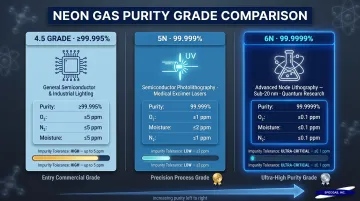
Neon purity ranges from industrial-grade suitable for lighting to ultra-high-purity grades required for advanced manufacturing:
Purity Grade Specifications:
- 4.5 Grade (≥99.995%): Basic semiconductor and laboratory applications with impurity limits around 2-5 ppm for oxygen and nitrogen
- 5N (99.999%): Required for most semiconductor photolithography, medical excimer lasers, and precision calibration with oxygen ≤1 ppm, moisture ≤2 ppm
- 6N (99.9999%): Ultra-high-purity for advanced node semiconductor lithography (sub-20 nm features) with oxygen and moisture ≤0.1 ppm
Semiconductor Lithography Dominance
Semiconductor manufacturing accounts for approximately 70% of global neon demand. Neon serves as a buffer and carrier gas in ArF (193 nm) and KrF (248 nm) excimer lasers that etch ultra-fine patterns on silicon wafers. These laser gas mixtures are typically 96-97.5% neon, with the remainder comprising reactive halogens and rare gases.
Even trace oxygen or moisture above 10 ppm degrades laser energy output and pattern precision. The result is measurable chip yield loss — which is why semiconductor fabs treat neon purity as a non-negotiable specification.
Medical and Laboratory Laser Applications
Excimer lasers for LASIK and PRK vision correction operate at 193 nm wavelengths, requiring medical-grade high-purity neon blends. Dermatological lasers and precision micromachining systems have similarly strict requirements.
Gas composition variations affect clinical outcomes and regulatory compliance — not just equipment performance. Medical facilities need both verified purity and reliable supply; an interrupted shipment can delay scheduled patient procedures.
Calibration and Analytical Standards
Neon appears in precision calibration gas mixtures for air quality monitoring, emissions testing, and analytical instrumentation. These applications demand exact concentration control and NIST traceability to ensure measurement accuracy.
Calibration gases for environmental monitoring carry strict regulatory requirements. Any concentration deviation invalidates compliance data, which is why laboratories require documented batch-to-batch consistency from their suppliers — not just a certificate on the first order.
Other Applications
Beyond the high-precision sectors above, neon also serves industrial lighting (lower purity acceptable), helium-neon lasers, plasma displays, and cryogenic cooling. Purity requirements vary considerably across these uses, so specifying your exact application — not just a generic purity grade — is essential when requesting quotes from suppliers.
Types of Neon Suppliers: Knowing Your Options
Large Industrial Gas Companies
Global majors—Linde, Air Liquide, Air Products, Messer Group—produce neon at scale from their own air separation units (ASUs) and control bulk supply chains. These companies typically prioritize long-term contracts with major semiconductor fabs and aerospace customers.
Advantages:
- Established global logistics networks
- Direct production from owned ASUs
- Financial stability and infrastructure depth
Limitations:
- High minimum order quantities
- Limited flexibility for custom blends or rush orders
- Long lead times for specialty configurations
- Less responsive to small-volume buyers
Specialty Gas Blenders
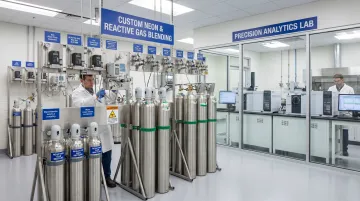
These suppliers source high-purity neon and blend it into application-specific mixtures—calibration gases, laser blends, rare gas formulations—using proprietary techniques. They excel at serving labs, research institutions, emissions monitoring operations, and OEM customers that need custom concentrations, NIST-traceable standards, or reactive mixtures with guaranteed stability.
SpecGas Inc., for instance, produces custom neon blends including excimer laser mixtures and calibration standards from its Pennsylvania facility. Its proprietary internal cylinder treatment process—developed through decades of specialty gas R&D—extends shelf life for reactive blends containing halogens or moisture-sensitive gases, where standard handling causes rapid degradation.
Advantages:
- Custom blend capabilities at PPM and PPB concentration levels
- NIST-traceable standards with detailed Certificates of Analysis
- Faster lead times due to in-house blending
- Technical support for application-specific questions
- Cost-effective cylinder deposit programs (vs. expensive rentals)
Limitations:
- May not produce raw neon (source from larger producers)
- Smaller production scale than global majors
Regional Gas Distributors
Where specialty blenders add technical depth, regional distributors primarily offer geographic convenience. They act as intermediaries, reselling gas from large producers. They offer local convenience and existing customer relationships but have limited ability to provide technical support, verify purity provenance, or source unusual specifications. Their capabilities are constrained by upstream suppliers.
Key consideration: Always ask who the actual gas source is and verify certifications directly. A distributor's Certificate of Analysis should trace back to the original producer's analytical data.
Emerging Domestic Producers
As governments invest in domestic neon capacity—facilities in South Korea, Taiwan, and the United States—new sources are becoming available. However, these carry qualification risk. Semiconductor fabs and analytical instrument manufacturers require 6-18 months of testing before accepting a new gas source into validated processes. Factor this extended timeline into long-term sourcing strategy, not emergency procurement plans.
Key Criteria for Evaluating a Neon Supplier
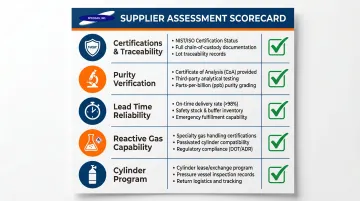
Certifications and Traceability
NIST Traceability means gas standards are certified against national measurement standards—required for calibration, emissions monitoring, and regulatory compliance applications. A NIST Traceable Reference Material is produced with well-defined traceability linkage to NIST, established via strict protocols.
What to verify:
- Request a Certificate of Analysis (CoA) with every order
- Confirm the CoA includes unique certificate identification, specified components, composition with uncertainty values, measurement traceability references, and expiry date (per ISO 6141 standards)
- Verify analytical instruments used for testing are properly calibrated
Purity Verification and Analytical Capability
A trustworthy supplier documents purity testing and maintains properly calibrated analytical equipment. Confirm whether the supplier performs in-house analysis or relies on third-party labs. Batch-to-batch consistency matters as much as absolute purity—a supplier that meets specifications once but varies between batches creates process problems.
- What analytical instruments do you use for purity verification?
- How do you ensure batch-to-batch consistency?
- Can you provide historical CoA data showing consistency over time?
Lead Times and Supply Reliability
Standard lead times vary widely by supplier and product specification. In supply-constrained markets, lead time becomes a competitive advantage. Suppliers with in-house blending and their own cylinder inventory can typically move faster than those dependent on third-party sourcing.
What to evaluate:
- Standard lead time for your specific grade and volume
- Availability of rush service and typical expedite timeframe
- Supplier's track record during past supply disruptions—ask specifically how they handled shortages and whether customers experienced delays
Capability with Reactive and Specialty Gas Mixtures
Once you've assessed logistics, evaluate whether the supplier can handle the chemistry your application demands. If you're working with reactive components blended with neon—common in calibration, emissions monitoring, and excimer laser applications—confirm the supplier has documented experience with reactive gas handling. Reactive gases can degrade in cylinders without proper internal treatment—halogens like fluorine react with cylinder walls unless the supplier follows passivation procedures.
Key questions:
- Do you have a documented or proprietary process for reactive gas mixture stability?
- Can you provide a stability guarantee for reactive neon blends?
- What shelf life can you document for mixtures containing reactive components?
Cylinder Program and Logistics
Understand the total cost of ownership beyond the gas price. Cylinder fees, return logistics, and delivery frequency all affect what you actually pay—and whether your operations run without interruption.
Considerations:
- CGA standards compliance (CGA P-1 for handling, CGA V-1/V-9 for valve connections, CGA C-10 for cylinder preparation)
- Disposable vs. refillable cylinder options for your volume and application
- Deposit vs. rental cost structure (deposit programs are typically more cost-effective long-term)
- Return pick-up services or logistics coordination
- Cylinder compatibility with your existing equipment connections
How to Vet a Neon Supplier: Red Flags and Questions to Ask
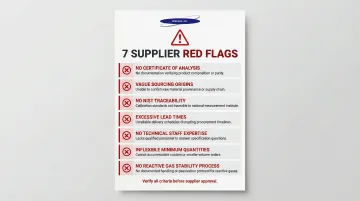
Red Flags to Watch For
- Inability or unwillingness to provide detailed Certificate of Analysis
- Vague answers about neon sourcing origin or upstream suppliers
- No mention of NIST traceability or third-party certification
- Very long lead times with no expedite options
- Lack of technical staff who can discuss gas specifications or application requirements
- Pressure to commit to large minimum quantities with no flexibility
- No documented process for reactive gas stability
Essential Pre-Purchase Questions
Certification and quality:
- "Can you provide a Certificate of Analysis and confirm NIST traceability for this specification?"
- "What analytical instruments do you use, and how often are they calibrated?"
Supply reliability:
- "What is your standard lead time for this product, and what rush options exist?"
- "How did your supply chain perform during the 2022 neon shortage—can you provide customer references from that period?"
Technical capability:
- "Do you blend in-house, and do you have a documented process for reactive gas mixture stability?"
- "Can you discuss my specific application and help confirm the right specification before I order?"
Commercial terms:
- "What is your cylinder program structure—deposit or rental—and what are total cost implications including demurrage?"
Vetting for Long-Term Reliability
Ask for customer references in your industry segment. Find out how the supplier handled the 2022 disruption — specifically what their customers experienced. A supplier who can explain how they maintained supply continuity during a market shock demonstrates real reliability, not just capability on paper.
Technical depth matters just as much. If a supplier cannot answer questions about purity grades, blend composition, or application suitability, treat that as a warning sign regardless of pricing.
Frequently Asked Questions
Who produces neon?
Neon is produced as a by-product of large-scale air separation at steel mills, where massive ASUs extract it from liquefied air. Historically concentrated in Ukraine and Russia, production capacity is now expanding in China, South Korea, Taiwan, and the United States following the 2022 supply disruption.
What purity grade of neon do I need?
Purity requirements depend on your application. Semiconductor lithography and medical excimer lasers require 5N–6N (99.999%–99.9999%) grades. Calibration and laboratory uses need high-purity grades with NIST traceability. General lighting and industrial discharge applications may accept lower-grade neon with higher impurity levels.
What certifications should I look for in a neon supplier?
NIST Traceability is essential for calibration and monitoring applications, ensuring gas standards meet national measurement criteria. Request a valid Certificate of Analysis for each lot, and verify the supplier uses properly calibrated analytical instruments.
How did the Ukraine war affect neon supply and pricing?
The February 2022 Russian invasion suspended Ukrainian refining operations, removing 45–54% of global semiconductor-grade neon supply overnight. Prices in China soared tenfold by March 2022, accelerating industry-wide diversification into recycling programs and new production capacity.
What is the difference between industrial-grade and high-purity neon?
Industrial-grade neon (typically 99.9% purity) works for lighting and basic discharge applications. High-purity 5N–6N grades used in semiconductor and calibration contexts carry far lower impurity levels—contaminants that would otherwise compromise laser performance and measurement accuracy in sensitive applications.
How do I ensure my neon supplier can handle reactive gas mixtures?
Ask specifically about internal cylinder treatment processes and reactive gas blending experience. Reactive components like fluorine or moisture-sensitive gases degrade without proper cylinder passivation. A supplier with documented stability guarantees, shelf life studies, and proprietary treatment protocols — such as SpecGas Inc.'s cylinder passivation process and Stability Guarantee — gives you concrete evidence of competence, not just a claim.