
Introduction
A gas detector is only as accurate as the calibration gas used to set it. In industries like semiconductor manufacturing, emissions monitoring, and air quality compliance, an instrument running on an imprecise blend can pass its check and still deliver wrong readings — a problem that stays hidden until a regulatory audit, a safety incident, or a failed product run forces the issue.
Treating calibration gas as a commodity purchase shifts cost to the front of the decision. The actual cost — in drift, downtime, and compliance exposure — accumulates quietly in the background.
This article explains the practical, operational benefits of precise calibration gas blends: what they protect, what they prevent, and why blend quality is a decision that directly affects measurement accuracy, regulatory standing, and operational risk over time.
Key Takeaways
- Precise calibration gas blends are certified reference mixtures that verify and adjust gas-measuring instruments to ensure accurate readings
- Accuracy, workplace safety, regulatory compliance, and instrument longevity all depend on blend precision
- Uncertified blends introduce undetectable error that compounds risk across operations, inspections, and safety protocols
- NIST-traceable blends provide verifiable accuracy chains that regulators and auditors accept
- Supplier blending methods and cylinder treatment determine whether accuracy holds from first use to expiration
What Are Precise Calibration Gas Blends?
Precise calibration gas blends are controlled gas mixtures prepared to exact, certified concentrations. They serve as reference standards to verify and adjust the sensitivity and accuracy of gas analyzers, monitors, and detectors across industrial, laboratory, and safety applications.
Two types serve distinct calibration functions:
- Zero-calibration gas — Non-reactive gas (typically nitrogen or air) used to establish a baseline "zero" reading on an instrument. Under 40 CFR 72.2, zero air must contain concentrations of SO2, NOx, or total hydrocarbons below 0.1 ppm, CO below 1 ppm, and CO2 below 400 ppm.
- Span-calibration gas — Contains a known, certified concentration of the target analyte (the specific gas being measured) to verify and adjust an instrument's response across its operating range. For daily calibrations, span gas typically represents 50-60% (mid-level) or 80-100% (high-level) of the instrument's full-scale range.
What separates a reliable calibration gas from an unreliable one comes down to three variables: the tightness of its certified concentration, stability over time, and traceability to a recognized national standard such as NIST. Without these, the blend cannot serve as a dependable reference point.
The federal Traceability Protocol sets a hard threshold here: calibration gases used for ambient air quality analyzers and continuous emission monitors must be certified with an analytical uncertainty (95% confidence interval) of no more than ±2.0% of the certified concentration.
Key Advantages of Precise Calibration Gas Blends
Each advantage below maps directly to an operational outcome and is relevant to any facility that relies on gas detection or analytical measurement for safety, quality control, or regulatory reporting.
Measurement Accuracy You Can Rely On
Gas sensors and analyzers inherently drift over time due to sensor wear, temperature exposure, and everyday use. OSHA explicitly confirms that "calibration drift" happens to all sensors through:
- Gradual chemical degradation
- Environmental extremes (temperature and humidity)
- Exposure to high concentrations of target gases
- Exposure to poisons such as volatile silicones and sulfide gases
A precisely composed calibration gas gives technicians a verified reference point to detect and correct drift before it produces bad data. Precision at the blend level—tight preparation tolerance, certified concentration, and NIST traceability—translates directly to instrument accuracy. When the blend's stated concentration is accurate, calibration adjustments are made against a true value rather than an approximated one.
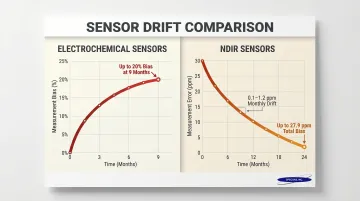
Instruments calibrated against imprecise blends carry forward a built-in error margin that accumulates across measurement cycles and can be impossible to detect without a traceable reference. Research on electrochemical sensors shows bias up to 20% after 9 months of continuous operation, while NDIR sensors exhibit long-term downward drifts of 0.1 to 1.2 ppm per month, with biases up to 27.9 ppm over two years.
This connects directly to decision-making risk. In research labs, emissions monitoring, and semiconductor manufacturing, data quality depends entirely on instrument accuracy. Bad calibration means bad data—which means flawed conclusions, failed inspections, or defective product.
Metrics most affected by measurement accuracy include:
- Instrument measurement accuracy and data repeatability
- Calibration cycle frequency and QC pass/fail rates
- Audit outcomes
Multi-component or low-concentration applications (ppm and ppb range) are most vulnerable. Even minor deviations in blend concentration cause disproportionate measurement error in emissions testing, semiconductor process gas monitoring, and research applications.
Safety and Regulatory Compliance
Gas detectors serve as the primary warning system against toxic gas exposure, oxygen deficiency, and flammable gas buildup. Their ability to alarm at the correct threshold depends entirely on calibration against a gas blend with the right certified concentration.
Precise calibration gas blends verify three things: the sensor responds to the correct target gas, it triggers alarms at the right threshold, and it doesn't produce false negatives or false positives. A missed alarm in a confined space can be fatal. An unnecessary evacuation shuts down operations and erodes worker trust in the detection system.
Between 2011 and 2019, the Bureau of Labor Statistics recorded 1,030 fatal injuries related to confined spaces in the United States, with 56% of confined space deaths due to hazardous atmospheres (oxygen deficiency or toxic gases). OSHA provides explicit guidance that test gas used for calibration must always be certified using a standard traceable to NIST, stating: "The instrument can only be as accurate as the test gas used for calibration."
The compliance stakes are just as real. Regulatory bodies including federal agencies and the FDA require proof that measuring instruments produce accurate readings. An uncertified or imprecise calibration gas can render instrument data inadmissible, trigger violations, and result in fines—particularly in pharmaceuticals, environmental monitoring, and food processing.
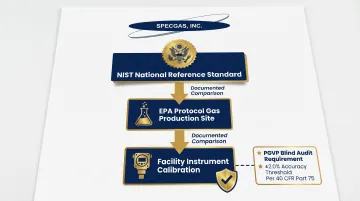
NIST traceability provides a documented, unbroken chain of comparisons to a recognized standard, making calibration data defensible in audits and inspections. Under 40 CFR Part 75, facilities must procure gases from qualified calibration gas production sites, which are subject to blind audits to ensure gases meet the ±2.0% accuracy requirement.
Key compliance metrics affected:
- Incident rates and worker exposure incidents
- Regulatory violation risk and audit pass rates
- Compliance documentation completeness
Highest-stakes environments include confined spaces, oil refineries, chemical plants, pharmaceutical sterile production, and emissions monitoring—operations subject to regulatory oversight where a miscalibrated instrument creates both safety risk and regulatory exposure at the same time.
Operational Efficiency and Equipment Longevity
When instruments drift undetected due to inadequate calibration gas, consequences show up as operational inefficiencies: wasted materials, product rework, packaging failures, process downtime, and quality escapes. All have measurable cost implications.
Precise, high-purity calibration gas blends also protect the physical components of measuring instruments. Impurities in low-quality blends can contaminate sensors, accelerate chemical wear, and shorten instrument life. High-purity, precisely formulated blends minimize this risk.
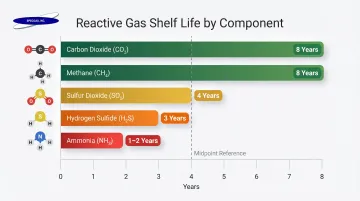
Reactive gas mixtures present a specific challenge. Certain gas components—hydrogen sulfide, ammonia, low-level nitric oxide—are chemically reactive and can destabilize inside a cylinder over time, changing their concentration before use. This makes the blend inaccurate at the point of calibration even if it was accurate when prepared.
Industry-recognized traceability guidelines establish that reactive gases have significantly shorter maximum certification periods compared to non-reactive gases:
| Gas Component | Maximum Certification Period |
|---|---|
| Carbon Dioxide | 8 years |
| Methane | 8 years |
| Sulfur Dioxide | 4 years |
| Hydrogen Sulfide | 3 years |
| Ammonia | 1 to 2 years |
Proprietary internal cylinder treatment processes directly address this degradation problem by extending blend stability and shelf life. SpecGas Inc. has developed a one-of-a-kind treatment for reactive gas mixtures that improves stability for gases like formaldehyde and low-concentration nitric oxide.
The cost-of-ownership math favors precision. Replacing sensors prematurely, repeating calibration cycles, or reworking product batches costs more than the price difference between a precisely blended gas and a lower-grade alternative. According to research by Aberdeen Group, unplanned downtime in manufacturing averages $260,000 per hour across industries—driven by lost production and emergency labor premiums.
Reactive gas applications, low-concentration (ppm/ppb) monitoring, and high-throughput facilities with frequent calibration cycles see the highest return from precise blending. Operations with long intervals between cylinder orders—where blend stability over time is critical—also benefit significantly.
Operational metrics most affected include:
- Instrument service life and sensor replacement frequency
- Calibration cycle reliability and gas blend shelf life
- Production rework rates and cost per calibration event
What Happens When Calibration Gas Precision Is Compromised
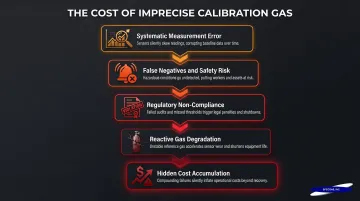
Imprecise, uncertified, or degraded calibration gas blends don't just produce bad data in isolation — they create cascading failures across instruments, compliance records, and operational costs. Here are the most common consequences:
Systematic measurement error compounds silently. Instruments read within expected range but report inaccurate values — data that appears valid while containing errors that accumulate across time and measurement points.
False negatives create direct safety risk. A photoionization detector (PID) with 20-30% signal loss from sensor degradation may read only 70-80 ppm when the actual concentration is 100 ppm. False positives cause the opposite problem, eroding worker trust in equipment and leading to ignored alarms.
Regulatory non-compliance follows documentation gaps. Under 40 CFR Part 75 Appendix B, a failed daily calibration error test invalidates all CEMS emission data from that hour forward until a successful recalibration is completed — a costly interruption for any facility under continuous emissions monitoring requirements.
Reactive gas degradation turns calibration against you. Every calibration event performed with an expired or unstabilized blend compounds inaccuracy rather than correcting it. Standard passivated aluminum cylinders allow reactive gases like NO2 to degrade within weeks, requiring specialized internal cylinder treatment to maintain concentration stability.
Hidden costs accumulate quickly. More frequent recalibration, premature sensor replacement, product rework, and compliance remediation rarely appear on a line item labeled "calibration gas decision." Contaminant poisons — silicon, lead, sulfur, or phosphorus-based compounds — can cause immediate catalytic sensor failure, turning a minor supply shortcut into a major equipment replacement expense.
How to Get the Most Value from Precise Calibration Gas Blends
Precise calibration gas delivers full value only when sourced from a supplier with documented quality controls. Look for certified concentrations with stated preparation tolerance, verified NIST traceability, and a clear expiration date—these are baseline indicators of a blend that will serve as a reliable reference.
Calibration frequency, storage, and cylinder integrity:
Calibration schedules should align with instrument manufacturer recommendations and environmental conditions, not arbitrary intervals. Key regulatory benchmarks include:
- Portable gas monitors: ISEA and OSHA recommend a bump test or calibration check before each day's use
- Emissions monitoring (40 CFR Part 75 Appendix B): daily calibration error tests, quarterly linearity checks, and semiannual or annual Relative Accuracy Test Audits (RATAs)
Storage conditions affect whether a precise blend remains accurate at the point of use:
- Store cylinders upright in a cool, dry, well-ventilated area between 50°F to 77°F
- No part of a cylinder should exceed 125°F
- Visually inspect cylinders before use per OSHA 29 CFR 1910.101
- Leak-check cylinders and regulators before calibration
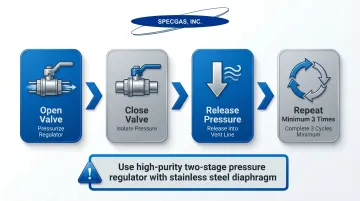
NIST recommends using a high-purity, two-stage pressure regulator with a stainless steel diaphragm for reactive gas mixtures. Regulators must be purged (minimum three times) to prevent accidental contamination by repeatedly opening the valve, pressurizing the regulator, closing the valve, and releasing pressure safely into a vent line.
One additional handling rule: do not use certified standards once internal cylinder pressure drops below 0.7 megapascals (100 psig), as lower pressure can cause concentration shifts that compromise accuracy.
Supplier expertise for reactive gas mixtures:
For reactive gas mixtures and low-concentration (ppm/ppb) applications, supplier expertise in internal cylinder treatment and blend stabilization is worth prioritizing. A supplier without that expertise can certify a blend at the time of fill—and deliver something different by the time it reaches your instrument. SpecGas Inc. addresses this through proprietary internal cylinder treatment developed specifically for reactive gas stability.
That process traces back to founder Alfred Boehm, a research chemist who spent decades specializing in reactive gas stabilization at Messer Griesheims Industries before establishing SpecGas in 2001. The result is extended shelf life for challenging gases like formaldehyde, hydrogen sulfide, and low-level nitric oxide. SpecGas backs this with a Stability Guarantee for reactive gas mixtures—meaning longer usable cylinder life and fewer emergency reorders.
Conclusion
Precise calibration gas blends are an investment in measurement integrity — and the return compounds across every instrument reading, safety check, and compliance record that depends on accurate gas standards.
The advantages of precision build over time: accurate instruments catch problems earlier, compliant documentation holds up under scrutiny, and well-maintained sensors last longer. The costs of imprecision, by contrast, stay hidden — until a safety event, failed audit, or process breakdown forces them into view.
Choosing a supplier with documented NIST traceability, proprietary cylinder treatment for reactive gas stability, and rigorous quality assurance makes the difference between gas standards that hold and ones that quietly degrade. SpecGas Inc. has built its reputation on exactly those capabilities — blending precision specialty gases since 2001 for labs, monitoring programs, and industrial operations that can't afford measurement uncertainty.
Frequently Asked Questions
What is the difference between zero-calibration gas and span-calibration gas?
Zero gas establishes a baseline "zero" reading using a non-reactive gas (such as nitrogen), confirming the instrument reads zero when no target analyte is present. Span gas contains a certified concentration of the target analyte and is used to calibrate an instrument's sensitivity across its operating range, typically at 50-60% or 80-100% of full-scale value.
What does NIST-traceable mean for a calibration gas blend?
NIST-traceable means the blend's composition has been verified against National Institute of Standards and Technology reference standards, with a documented chain of custody linking field measurements back to those national benchmarks. This ensures accuracy is independently verifiable and results are accepted by regulatory bodies.
Why do calibration gas blends have an expiration date?
All blends have finite shelf life because gas components can interact with cylinder walls or each other over time, changing concentration. Reactive gas mixtures are especially susceptible—hydrogen sulfide expires in 3 years, ammonia in 1-2 years—requiring specialized cylinder treatment and proper storage to maintain blend accuracy through the expiration date.
What happens if an instrument is calibrated with an imprecise gas blend?
The instrument is adjusted to match an inaccurate reference, meaning all subsequent readings carry built-in error. In safety-critical applications, this can mean missed alarms (false negatives) or unnecessary alarms (false positives). In regulated industries, it can mean non-compliant data that fails audits and triggers violations.
How are reactive gas mixtures stabilized in a cylinder?
Reactive gases require specialized internal cylinder preparation to prevent interaction with cylinder walls or other blend components. SpecGas Inc.'s proprietary treatment process—developed through decades of R&D—extends the stability and shelf life of reactive blends including formaldehyde, hydrogen sulfide, and low-concentration nitric oxide.
How often should calibration gases be replaced or reordered?
Always calibrate with blends within their certified date range, and plan reorders before expiration to avoid using degraded gas. Reactive gases like ammonia (1-2 year shelf life) need more frequent replacement than stable blends like carbon dioxide, which lasts up to 8 years. Calibration frequency, cylinder size, and storage conditions also affect reorder timing.