This is why H2S detector calibration isn't a maintenance formality. It's the last line of defense before a worker enters a space that could kill them.
Yet safety managers and confined space teams regularly struggle with the same practical questions: Which H2S concentration do I order? Does my detector need air-balanced or nitrogen-balanced gas? What's the difference between a bump test and a full calibration? This guide answers those questions with specifics — including how regulatory thresholds translate into calibration gas decisions, what detector compatibility actually means in practice, and what to have ready before you order.
Key Takeaways
- H2S causes olfactory paralysis at dangerous concentrations — your detector is the only safeguard you can actually rely on
- OSHA's H2S ceiling is 20 ppm; the NIOSH IDLH is 100 ppm — alarm setpoints should align with these thresholds
- Always confirm calibration gas concentration from your instrument manufacturer's manual — no generic formula applies
- Untreated cylinders degrade H2S — proper cylinder passivation and NIST-traceable sourcing are non-negotiable
- Bump tests and full calibrations serve different purposes but use the same calibration gas
- Balance gas selection depends on your specific detector configuration — always verify with the manufacturer
Why H2S Calibration Is Non-Negotiable for Confined Space Entry
The Physical Properties That Make H2S So Dangerous
H2S has a molecular weight of 34.081 and a relative gas density of 1.19 — meaning it's heavier than air. It sinks to the lowest points of a confined space: the bottom of a manure pit, the floor of a sewer vault, the base of a drainage shaft. Workers descending into these spaces can move through a breathable atmosphere and step directly into a lethal concentration.
The olfactory problem compounds the physical hazard. The odor threshold is 0.01–1.5 ppm, but smell becomes unreliable almost immediately at higher concentrations. Both NIOSH and OSHA are unequivocal: do not rely on your sense of smell to detect H2S.
What Happens Without Accurate Detection
Between 2011 and 2017, H2S caused 46 worker deaths in the U.S. The pattern in fatal incidents is consistent: workers enter a space, the detector either wasn't calibrated, wasn't used, or gave a false reading — and there's no second chance.
An uncalibrated H2S sensor can fail in two ways that both endanger workers:
- False lows — the sensor reads lower than actual concentration, giving workers a false sense of safety
- Missed alarms — the sensor fails to trigger at the configured threshold because its output has drifted
OSHA 29 CFR 1910.146(c)(5)(ii)(C) requires pre-entry atmospheric testing with a calibrated direct-reading instrument before any confined space entry. That word — calibrated — carries legal weight. An uncalibrated instrument doesn't satisfy this requirement.
Why Electrochemical Sensors Require Regular Verification
Satisfying that legal requirement depends on your sensor actually working. Most portable H2S detectors use electrochemical sensors — generally long-lived and accurate, but vulnerable to sudden sensitivity loss at end-of-life or after exposure to organic solvents and other contaminants. A sensor that passed calibration three months ago may read 30% low today.
Exposing it to a known H2S concentration using a certified, NIST-traceable calibration gas standard is the only way to confirm the sensor's current output is accurate and that alarms will trigger at the right threshold.
Understanding H2S Exposure Limits and What They Mean for Calibration
The Key Regulatory Numbers
These thresholds inform how H2S detectors are configured and what calibration gas you need to verify those configurations:
| Standard | Value | Meaning |
|---|---|---|
| OSHA PEL (General Industry) | 20 ppm ceiling | Acceptable ceiling concentration under 29 CFR 1910.1000 Table Z-2 — not an 8-hour TWA |
| OSHA Peak Allowance | 50 ppm, max 10 min | Single-occurrence exception under Table Z-2 only |
| NIOSH REL | 10 ppm, 10-min ceiling | More conservative than OSHA's PEL |
| NIOSH IDLH | 100 ppm | Immediately dangerous to life or health |
| ACGIH TLV-TWA / STEL | 1 ppm / 5 ppm | Most conservative — often adopted in oil and gas |
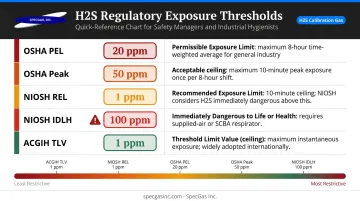
Important correction on the PEL: OSHA's 20 ppm value is a ceiling, not an 8-hour TWA. This distinction matters when configuring detector alarm setpoints. Most confined space 4-gas monitors set a low H2S alarm at or below the OSHA ceiling and a high alarm approaching the NIOSH IDLH.
Alarm Setpoints and Calibration Gas
Calibration gas must be sufficient to verify the sensor responds correctly at each alarm threshold. If a detector has a low alarm at 10 ppm and a high alarm at 15 ppm, a 10 ppm calibration gas verifies the low alarm response — but doesn't confirm the sensor's accuracy across its full range. The practical rule: your calibration gas concentration should exceed your highest alarm setpoint so the sensor is tested across its full response range, not just at the lower threshold.
One more calibration context worth noting: the LEL of H2S is 4.0% by volume — 40,000 ppm. H2S becomes acutely lethal at concentrations well under 1/400th of that threshold. For confined space monitoring, the toxic ppm thresholds are the critical concern, not the combustible risk.
H2S Calibration Gas Concentrations: Selecting the Right One
Why There's No Universal Rule
A commonly cited principle states calibration gas should represent 50–75% of the detector's full-scale range. This provides a reasonable starting framework, but manufacturer defaults don't always follow it. Real examples:
- Honeywell BW multi-gas detectors: default H2S calibration gas is 25 ppm
- Dräger X-am 2500: default is 15 ppm H2S, with an allowed test gas range of 5–99 ppm on a 0–100 ppm sensor
- Honeywell RAE standard H2S sensor (0–100 ppm): 10 ppm H2S, balance nitrogen
- MSA ALTAIR 4XR: approximately 20 ppm H2S in multi-gas mix
Always confirm the concentration with your instrument manual before ordering. The 50–75% rule is a ballpark, not a specification.
Common H2S Calibration Gas Concentrations at a Glance
| H2S Concentration | Typical Detector Range | Common Application |
|---|---|---|
| 10 ppm | 0–50 ppm or 0–100 ppm | Low-range sensors; verifying response near OSHA PEL |
| 15–25 ppm | 0–100 ppm | Most common for 4-gas confined space monitors (Honeywell BW, Dräger, MSA defaults) |
| 50–75 ppm | 0–100 ppm | Higher-range bump testing; industrial hygiene surveys |
| 100 ppm+ | 0–200 ppm or higher | High-H2S industrial environments; oil and gas applications |
Why Cylinder Quality Matters More Than Concentration
H2S is a reactive gas. Research on H2S standard stability and Restek's sulfur compound work document that untreated cylinder walls can cause 34% sulfur loss within 24 hours in stainless steel. The labeled concentration on a poorly treated cylinder may not reflect what's actually inside — which means you could be calibrating your detector to a wrong reference value.
NIST-traceable calibration gas from a supplier with proper cylinder passivation is the only protection against this. SpecGas Inc. uses a proprietary internal cylinder treatment process to keep H2S concentration stable from first use through end of shelf life. The SpecGas Stability Guarantee covers H2S and other reactive gas mixtures, so the labeled concentration holds for the full shelf life of the cylinder.
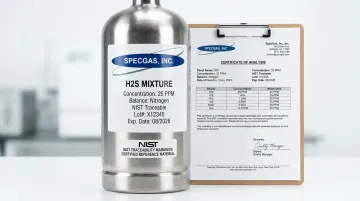
Cylinder quality is just as relevant when choosing between a multi-gas blend and a standalone H2S mix — because either format is only reliable if the gas inside stays stable.
Multi-Gas Blends vs. Single-Gas H2S
A single quad-gas mixture calibrates most confined space 4-gas monitors (O2, LEL, CO, H2S). Common configurations include:
- Honeywell BW default mix: 18.0% O2 / 50% LEL CH4 / 100 ppm CO / 25 ppm H2S
- Dräger X-am 2500 default mix: 18 vol.% O2 / 2.5 vol.% CH4 / 50 ppm CO / 15 ppm H2S
Calibrating the H2S sensor separately with a standalone blend makes sense when:
- The H2S sensor has a different range than the multi-gas default supports
- You're troubleshooting a specific sensor issue in isolation
Detector Compatibility: Balance Gas, Sensor Type, and Cross-Sensitivity
Balance Gas: Nitrogen vs. Air
This is one of the most common ordering mistakes. The answer depends entirely on your detector configuration:
- 4-gas monitors with an O2 sensor: Require a calibration gas that includes oxygen — typically 18–18.5% O2. The electrochemical O2 sensor needs oxygen present to function. Check whether the balance is nitrogen or air; what matters is the stated O2 percentage.
- Standalone H2S sensors: Often specified with nitrogen balance gas (no added O2 required).
- Verify before ordering — for example, the Honeywell RAE TN-114 specifies nitrogen balance even for its 0–100 ppm H2S sensor. Other configurations require oxygen-containing mixtures.
Rule: Check the instrument manual for the exact O2 percentage and balance gas requirement. Order to that specification.
Cross-Sensitivity: Why Calibration Gas Purity Matters
Electrochemical H2S sensors respond to gases other than H2S. Real cross-sensitivity data:
- SO2 at 5 ppm → reads as ~1 ppm H2S (Honeywell RAE standard sensor)
- NO at 50 ppm → reads as 13 ppm H2S (MSA ALTAIR 4XR)
- CO at 100 ppm → reads as ~1 ppm H2S (MSA ALTAIR 4XR)
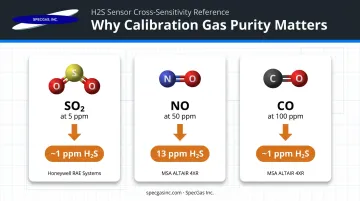
If your calibration gas contains trace impurities of these interfering gases, the calibration itself introduces error. Request a certificate of analysis — it should state individual component purity, confirm NIST traceability, and document the blend date and cylinder lot number.
Flow Rate Requirements
Flow rates vary by instrument — use the wrong rate and calibration gas won't reach the sensor properly:
- Dräger X-am 2500: 0.5 L/min
- MSA ALTAIR 4XR: 0.25 L/min
- Honeywell BW Clip4: 250–500 mL/min
Use the instrument manufacturer's specified regulator and flow rate. Once you've confirmed balance gas, sensor type, and flow requirements, you have everything needed to specify the right cylinder — which is what the next section covers.
Bump Test vs. Full Calibration: What's the Difference?
Both procedures use the same calibration gas. The distinction is what they do with it:
| Bump Test | Full Calibration | |
|---|---|---|
| Purpose | Confirms sensor responds and alarm triggers | Adjusts sensor output to match known concentration |
| Adjusts readings? | No | Yes |
| Duration | ~15–20 seconds | ~1–2 minutes |
| Frequency | Before each day's use in confined space applications | Per manufacturer schedule, or when bump test fails |
| OSHA reference | OSHA SHIB 09/30/2013 | Same document |
That table summarizes the roles, but the operational implication matters more: the bump test is what catches a failed or drifted sensor before a worker enters the space. Skipping it — even after a recent full calibration — means an undetected sensor failure becomes a live risk.
When a bump test reading falls outside acceptable tolerance, a full calibration is required. If the sensor still can't be brought into tolerance after calibration, replace the sensor.
How to Order H2S Calibration Gas: A Step-by-Step Guide
What Information to Have Ready Before You Order
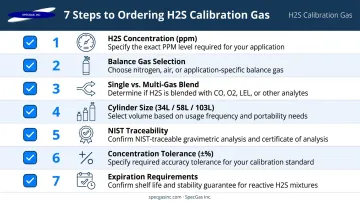
Gather these specifications before contacting any supplier:
- H2S concentration (ppm) — from your instrument manual or manufacturer's calibration gas chart
- Balance gas — nitrogen or specified O2 percentage (e.g., 18% O2, balance nitrogen)
- Single gas or multi-gas blend — if multi-gas, list all components and concentrations
- Cylinder size — 34L for field/portable use; 58L for mid-volume; 103L for high-frequency programs
- NIST traceability — required for legally defensible calibration records
- Concentration tolerance — check whether your instrument requires ±2% or ±5% of labeled value
- Expiration requirements — verify shelf life will cover your calibration interval
Cylinder size trade-offs:
- 34L: Portable, suited for field bump testing or occasional use
- 58L: Mid-range — good balance of portability and economy for reactive gas mixtures
- 103L: Best cost-per-use for facilities with multiple detectors or high-frequency programs
Working With a Specialty Calibration Gas Supplier
H2S is reactive. A general industrial gas distributor may not have the cylinder passivation process, blending verification protocols, or reactive gas expertise to guarantee concentration stability over the cylinder's shelf life. Ordering from a non-specialist often means shorter shelf life, inconsistent concentration at delivery, and unpredictable lead times — none of which work for a life-safety program.
SpecGas Inc. has been blending reactive gas mixtures — including H2S from 300 ppb to 10% — since 2001. Key capabilities for confined space programs include:
- Proprietary internal cylinder treatment for reactive gas stability, backed by the SpecGas Stability Guarantee
- NIST-traceable blends across all standard and custom H2S concentrations
- Custom concentrations blended to match any instrument specification
- Fast turnaround times and a cylinder deposit program as an alternative to rental fees
For confined space applications where detector accuracy is a life-safety issue, the supplier's reactive gas expertise and traceability documentation aren't optional — they're what makes the calibration legally defensible.
Frequently Asked Questions
How often do H2S monitors need to be calibrated?
Most instrument manufacturers and OSHA guidance recommend a functional bump test before each day's use in confined space applications. Full calibration should follow the manufacturer's schedule — typically every 3–6 months under normal conditions — or whenever a bump test reading falls outside acceptable limits.
What is the acceptable level of H2S in a confined space?
OSHA's H2S ceiling for general industry is 20 ppm under 29 CFR 1910.1000 Table Z-2. The NIOSH IDLH is 100 ppm. For confined space entry, the permit must establish H2S alarm setpoints aligned with these thresholds, and atmospheric concentration must fall below those setpoints before entry is authorized.
What is the difference between a bump test and a full calibration for H2S detectors?
A bump test confirms the sensor responds to H2S and triggers the alarm — it doesn't adjust any readings. A full calibration corrects the sensor's output to match the certified concentration of the calibration gas. Both procedures use the same calibration gas standard.
What balance gas should I use in an H2S calibration cylinder — nitrogen or air?
For 4-gas confined space monitors with an electrochemical O2 sensor, the calibration gas must include oxygen (typically 18% O2) — the balance can still be nitrogen, but the stated O2 content is what matters. For standalone H2S sensors, nitrogen balance is commonly specified. Always confirm the required balance gas in your instrument manufacturer's documentation.
How long does H2S calibration gas stay stable in a cylinder?
H2S is reactive and can degrade in improperly treated cylinders, reducing accuracy before the expiration date. Shelf life typically ranges from 6 to 36 months depending on gas mixture and cylinder treatment. Always verify the expiration date and certificate of analysis before use — and source from a supplier with a documented passivation process for reactive gases, such as SpecGas's proprietary cylinder treatment backed by the SpecGas Stability Guarantee.