The reality is more demanding. Blend ratio, flame behavior, equipment compatibility, and measurement accuracy all interact in ways that make hydrogen-methane combustion a genuine engineering problem — not a policy default or simple gas swap.
This article covers what the process is, how it works chemically and mechanically, where it is deployed, and what factors most affect performance and emissions outcomes.
Key Takeaways
- Hydrogen-methane combustion reduces CO₂ by displacing carbon-bearing methane with hydrogen, which burns to produce only water vapor.
- A 20 vol-% H₂ blend delivers roughly 6–7% CO₂ reduction — not 20% — because hydrogen carries far less energy per unit volume than methane.
- Hydrogen increases flame speed, lowers ignition energy, and raises flame temperature, creating both performance and NOx trade-offs.
- Near-term infrastructure-compatible blends typically run 5–20 vol-% H₂; higher ratios require modified equipment and engineered controls.
- Blend composition must be verified against NIST-traceable calibration gas standards — accurate measurement is the baseline for safe, compliant operation.
What Is Hydrogen-Methane Mixture Combustion?
Hydrogen-methane combustion is the exothermic reaction that occurs when a blended fuel of H₂ and CH₄ is ignited in the presence of oxygen. Both reactions happen simultaneously:
- Hydrogen oxidation: 2H₂ + O₂ → 2H₂O + heat
- Methane combustion: CH₄ + 2O₂ → CO₂ + 2H₂O + heat
The hydrogen fraction produces only water vapor. The methane fraction produces water vapor and CO₂. Both heat output and emissions profile scale with blend ratio.
How It Differs from Pure Fuels
| Fuel | CO₂ Output | Flame Behavior | Infrastructure Fit |
|---|---|---|---|
| Pure methane | CO₂ + H₂O at every combustion event | Predictable, well-characterized | Existing gas infrastructure |
| Pure hydrogen | No CO₂ — H₂O only | Extreme: wide flammability range, very high flame speed | Requires dedicated H₂ infrastructure |
| H₂/CH₄ blend | CO₂ reduced proportionally to CH₄ displaced | Between the two — manageable with engineering | Compatible with existing systems at lower ratios |
For facilities that cannot yet commit to pure hydrogen, this middle-ground profile has real operational value:
- Emissions drop in direct proportion to the hydrogen fraction added
- Flame behavior stays manageable at lower H₂ ratios (typically below 30% by volume)
- Existing natural gas infrastructure can handle blends without full system replacement
Why Blend Hydrogen with Methane for Energy?
The Decarbonization Case
Every combustion event burning pure methane produces CO₂. Replacing even a fraction of that methane with hydrogen reduces the carbon content of the fuel directly. According to IEAGHG research, the approximate CO₂ reductions at common blend ratios are:
- 5 vol-% H₂: ~1.5–2% CO₂ reduction
- 10 vol-% H₂: ~3–4% CO₂ reduction
- 20 vol-% H₂: ~6–7% CO₂ reduction
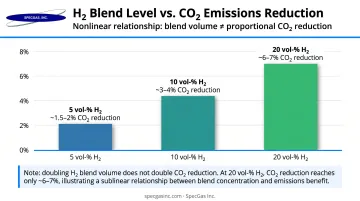
Those numbers are smaller than the blend percentages suggest. Hydrogen's lower heating value is 274.7 Btu/scf versus methane's 911.6 Btu/scf, meaning hydrogen carries roughly one-third the energy per unit volume.
Substituting 20% of the gas volume by hydrogen does not substitute 20% of the energy or 20% of the carbon. Equipment must deliver more volumetric flow to maintain the same heat output, and the CO₂ arithmetic must account for stoichiometry (the actual molar ratios of combustion), not just volume fraction.
Infrastructure Compatibility
The practical advantage of hydrogen-methane blending is that existing pipelines, burners, and combustion systems can often handle modest H₂ fractions without complete replacement. The EU standard EN 16726 governs H-gas quality parameters including Wobbe Index and hydrogen content — a relevant reference for grid operators managing H₂ injection into natural gas networks.
Country-specific limits vary considerably. ENTSOG data shows:
- Belgium and Italy: 2 mol-% maximum
- Spain: 5%
- Austria: up to 10%, subject to case-by-case assessment
- Netherlands: as low as 0.02–0.5 mol-% in some grid areas
There is no universal threshold. Every jurisdiction and application requires its own review.
What Goes Wrong Without Precise Blend Control
- Burner instability from uncharacterized flame behavior
- Incorrect emissions calculations and compliance failures
- Equipment calibrated for pure methane running out of spec on a blend
- Inaccurate CO₂ and NOx reporting to regulators
Imprecise blend composition at the measurement stage is where these failures originate. Getting the composition right upstream is what keeps burner performance, emissions data, and regulatory reporting aligned.
How Hydrogen-Methane Combustion Works
Process Flow
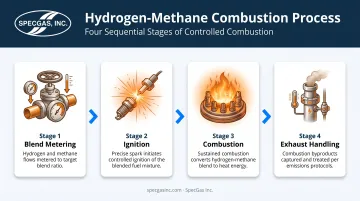
The combustion sequence follows these steps:
- Blend metering — H₂/CH₄ ratio is set at the gas supply
- Ignition — spark or pilot flame initiates combustion in the burner or chamber
- Combustion — blended fuel burns in air, releasing heat for industrial use, power generation, or space heating
- Exhaust handling — stack gases (primarily H₂O vapor, CO₂, and thermal NOx) are discharged or captured in combined heat and power systems
Ignition and Flame Initiation
Hydrogen changes the ignition characteristics of the blend significantly:
- Flammability range: H₂ is flammable from 4–75% in air; methane from approximately 5–15%. Blending H₂ into CH₄ widens the flammable range proportionally.
- Minimum ignition energy: Hydrogen's MIE is roughly 1.9 × 10⁻⁸ Btu versus methane's 2.7 × 10⁻⁷ Btu — about an order of magnitude lower.
Both effects compound as H₂ content rises, which is why burner design and safety protocols need reassessment well before reaching high hydrogen fractions.
Flame Propagation and Temperature
NREL/Sandia data quantifies the flame behavior gap clearly:
| Parameter | Methane | Hydrogen |
|---|---|---|
| Laminar flame speed | 30–40 cm/s | 200–300 cm/s |
| Adiabatic flame temperature | ~3,565°F (~1,960°C) | ~4,000°F (~2,200°C) |
In a blend, both parameters increase as H₂ content rises. Faster flame propagation raises flashback risk, where flames travel back into the burner rather than staying anchored at the combustion face. Higher flame temperatures add thermal stress to combustion hardware and heat exchangers. Together, these effects mean burner geometry, materials, and cooling designs rated for pure methane may need reassessment at even moderate H₂ fractions.
Combustion Products and NOx Formation
The emissions split is straightforward in principle — hydrogen produces water vapor, methane produces CO₂ and water vapor — but NOx introduces a meaningful trade-off.
Thermal NOx forms when nitrogen and oxygen react at temperatures above approximately 2,800°F (1,538°C). Because H₂ enrichment raises flame temperature, it increases thermal NOx output — often by a measurable margin. Peer-reviewed modeling published in Fuel (2022) found that H₂ addition to methane significantly increases NO while suppressing CO under gas-turbine-relevant conditions. The same study found that reducing the equivalence ratio from 1.2 to 0.6 (leaner operation) was highly effective in bringing NO back down.
Engineering controls for NOx in H₂-enriched combustion include:
- Lean premix combustion — operates with excess air to keep overall flame temperature below the thermal NOx threshold
- Exhaust gas recirculation (EGR) — dilutes oxygen concentration and reduces peak temperatures
- Staged combustion — introduces fuel and air in separate zones, preventing localized hot spots
- Selective catalytic reduction (SCR) — downstream aftertreatment for applications where NOx limits are strict
Key Factors That Affect Combustion Performance
Blend Ratio
The H₂ volume fraction is the single most impactful variable in the system. It governs:
- Wobbe Index — a measure of fuel interchangeability that determines how a burner responds to fuel changes. European data shows the Wobbe Index shifting from ~49.4–50.0 MJ/m³ for methane to ~47.6–47.8 MJ/m³ at 20 vol-% H₂, a difference that affects heat input rates in existing appliances.
- Flame speed and flashback risk
- NOx formation potential
- Equipment compatibility requirements
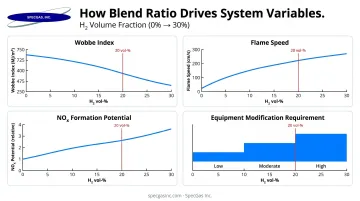
Blends above roughly 20 vol-% H₂ begin to require more substantial modifications — to burners, seals, valves, and monitoring systems — than lower-ratio blends.
Gas Composition Accuracy
Because blend ratio governs combustion outcomes, measurement accuracy is central to everything downstream. Flow meters, gas chromatographs, NDIR analyzers, and CEMS equipment used to verify blend composition must all be calibrated against certified reference gas standards to deliver reliable data.
Gas chromatographs verifying H₂ content, NDIR systems monitoring CO₂ in exhaust, and electrochemical sensors tracking NOx each require calibration standards that accurately represent the gases being measured. An instrument calibrated incorrectly reports incorrect blend data — and that error propagates into every combustion, emissions, and compliance calculation that follows.
SpecGas Inc. produces NIST-traceable H₂ and CH₄ calibration gas standards, along with CO₂ and NOx/NO mixtures, and can blend multi-component standards for complex instrument calibration requirements. Rush service is available when blend ratios change and immediate recalibration is needed.
Operating Conditions
- Air-to-fuel ratio (equivalence ratio λ): Lean operation (excess air, λ > 1) reduces flame temperature and lowers NOx, but hydrogen's wide flammability range means lean blends can still ignite in conditions that would extinguish a pure methane flame. Stability margins require site-specific validation.
- Pressure: Higher operating pressure affects flame speed and NOx formation rates.
- Temperature: Preheated air or fuel raises flame temperature further, compounding NOx risk in H₂-enriched systems.
Equipment and Materials Compatibility
Hydrogen presents material compatibility challenges that natural gas does not:
- Hydrogen embrittlement can affect certain steel alloys, reducing fracture resistance — even at hydrogen partial pressures near 1 bar
- Permeation through elastomeric seals not rated for H₂ service
- ASME B31.12 provides design guidance for hydrogen piping; API 617 limits steel yield strengths in compressor applications where H₂ partial pressure exceeds 6.89 bar
Engineers should conduct a formal compatibility review before commissioning any system beyond the lowest blend fractions — applicable standards vary by jurisdiction and blend level.
Where Hydrogen-Methane Combustion Is Applied
Real deployments span multiple sectors, with blend ratios varying considerably by application:
| Sector | Example | Blend Ratio |
|---|---|---|
| Public gas network (UK) | HyDeploy2 — abated over 50 tCO₂ in live distribution network trials | Beyond standard UK GSMR limits in controlled trial |
| Public gas network (Hawaii) | Hawaii Gas, Oahu — long-running blend operation | ~12–15 vol-% H₂ since the 1970s |
| Industrial gas turbine (CHP) | HYFLEXPOWER project, Siemens Energy | 30 vol-% H₂ mixed with natural gas (2022) |
| Grid-connected power generation | Plant McDonough-Atkinson, Mitsubishi Power | 50 vol-% H₂ blend testing on advanced-class turbine |
| Gas turbine fleet (OEM) | GE Vernova | Operational experience from 5 vol-% to 100 vol-% H₂ |
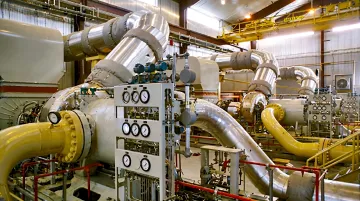
Emissions monitoring and compliance is its own distinct application sector. Facilities burning blended fuels must measure and report CO₂ and NOx accurately as blend ratios change — sometimes seasonally or based on grid operator directives.
CEMS equipment calibrated for pure natural gas won't produce accurate readings on a blend without recalibration against composition-matched reference standards.
Beyond compliance applications, research and testing laboratories are another active area. Controlled combustion experiments with defined H₂/CH₄ ratios require precise reference gas standards to validate measurement instruments and model predictions.
Common Issues and Misconceptions
Hydrogen Blending Is Not a Drop-In Process
Many operators assume that injecting hydrogen into a natural gas supply requires no operational adjustment. Even modest H₂ fractions — especially above 15–20 vol-% — can shift Wobbe Index values enough to affect heat input rates, alter flame stability, and produce emissions readings that no longer match calibration baselines. Equipment that has run correctly on pure methane for years should not be assumed to run correctly on a blend without prior engineering review.
Blending Reduces CO₂ — But Less Than the Volume Ratio Suggests
It reduces them — proportionally, and less than the volume percentage implies. A 20 vol-% H₂ blend produces roughly 6–7% less CO₂, not 20% less. The difference comes from hydrogen's lower volumetric energy density (approximately one-third that of methane). More hydrogen by volume is needed to deliver equivalent energy. The CO₂ reduction calculation must account for the stoichiometry of both reactions — not just the volumetric substitution ratio.
NOx Cannot Be Treated as an Afterthought
For teams focused exclusively on CO₂ reduction, NOx frequently gets underweighted. Higher H₂ content raises flame temperature, and thermal NOx formation increases accordingly. In many jurisdictions, NOx is a regulated emission with permit thresholds. A combustion optimization plan that achieves CO₂ targets while breaching NOx limits has not achieved compliance — it has traded one problem for another. NOx controls — burner staging, flue gas recirculation, or selective catalytic reduction — need to be scoped alongside CO₂ targets from the outset, not added as a retrofit after permit violations surface.
Frequently Asked Questions
What is a hydrogen-methane gas mixture?
A hydrogen-methane mixture is a blended fuel combining H₂ and CH₄ at a defined ratio, used in energy applications to reduce carbon emissions while utilizing existing natural gas infrastructure. The hydrogen fraction burns to produce water vapor only; the methane fraction produces CO₂ and water vapor.
What percentage of hydrogen is typically blended with methane for combustion?
Near-term infrastructure-compatible blends typically run 5–20 vol-% H₂, with the IEAGHG reporting the most meaningful CO₂ reductions (6–7%) at the 20 vol-% level. Higher concentrations — 30–50 vol-% and above — are used in engineered industrial or power generation pilots with modified equipment.
How does adding hydrogen to methane affect NOx emissions?
Hydrogen blending reduces CO₂ but raises flame temperature, which increases thermal NOx formation. Managing this trade-off requires lean premix combustion, exhaust gas recirculation, or aftertreatment systems — not simply accepting higher NOx as inevitable.
Does hydrogen-methane combustion require modified burners or equipment?
Low-level blends under approximately 15–20 vol-% H₂ can often operate in existing systems with limited adjustment, but higher ratios require burner modifications, material compatibility verification, and recalibration of flow meters and emissions monitoring instruments.
What are the flammability risks of hydrogen-methane fuel mixtures?
Hydrogen alone is flammable from 4–75% in air, far wider than methane's 5–15% range. Blending H₂ into methane expands the mixture's flammable envelope, requiring updated leak detection, ventilation standards, and ignition control protocols relative to pure natural gas operation.
How much does hydrogen fuel cost compared to natural gas?
U.S. Henry Hub natural gas averaged $2.21/MMBtu in 2024. The IEA projects low-emissions hydrogen costs of $2–9/kg by 2030 — significantly higher on an energy-equivalent basis. Partial blending at lower ratios remains the more economical near-term approach, with the gap narrowing as green hydrogen production scales.
Conclusion
Hydrogen-methane combustion is a technically viable, infrastructure-compatible pathway for reducing carbon emissions from gas combustion. It is not a simple gas swap. Blend ratio governs combustion behavior, equipment stress, CO₂ reduction potential, and NOx output simultaneously — and the relationship between volume percentage and emissions outcome is nonlinear in ways that matter for compliance.
Facilities operating on blended fuels need accurate gas composition data at every stage: blending verification, combustion control, and stack emissions reporting. That accuracy depends on analytical instruments calibrated against certified reference gas standards that represent the actual blend in use. When blend ratios change — whether driven by policy, grid operator directives, or seasonal targets — recalibration is required every time.
Facilities that manage this well treat calibration gas selection as part of the blend management process — not an afterthought once the ratio is set. From stoichiometry to Wobbe Index to NOx trade-offs, the operational details determine whether hydrogen blending delivers on its emissions reduction potential or creates compliance exposure.