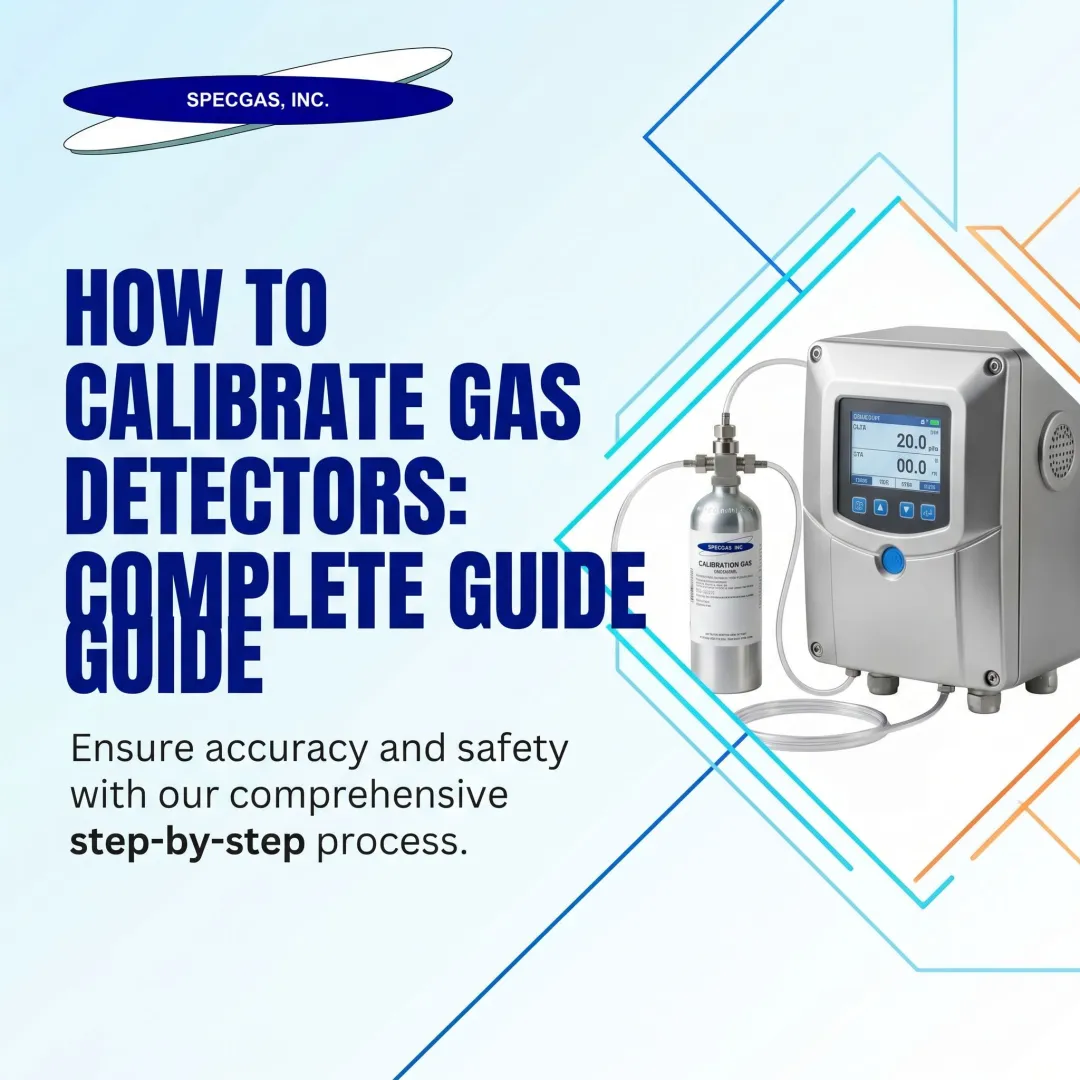

Introduction
Gas analyzer calibration is the foundation of accurate measurement—whether for emissions compliance, air quality monitoring, lab analysis, or process control. A poorly calibrated analyzer doesn't just produce bad data; it can trigger false alarms, fail regulatory audits, or miss hazardous gas concentrations entirely. EPA consent decrees document stipulated penalties reaching $27,500 per day for CEMS-related data invalidation due to failed calibration checks.
Real-world calibration results vary widely depending on the gas used, environmental conditions, equipment setup, and whether the process follows a documented protocol. Each variable introduces its own failure mode.
For instance, rushing a 90-minute warm-up down to 30 minutes creates baseline errors that no subsequent adjustment can correct. Using an expired or unstable reactive gas blend is equally damaging — it silently corrupts every measurement that follows.
This guide covers the equipment and gases required, the step-by-step calibration process, the variables that affect accuracy, recalibration intervals, and the most common mistakes that undermine results.
TL;DR
- Gas analyzer calibration involves introducing known reference gases (zero and span) and adjusting instrument output to match certified concentrations
- Use NIST-traceable certified mixtures with ±2% analytical uncertainty to produce defensible compliance results
- Proper calibration includes zero check, span check, and multi-point linearity verification across at least 5 concentration points (required for EN14181)
- Calibrate every 3 months to 1 year depending on application, plus after any repair, relocation, or major maintenance event
- Common failure causes: skipped warm-up time, expired or unstable gases, and unaccounted pressure or temperature conditions
What You Need Before Calibrating a Gas Analyzer
Preparation directly determines whether calibration results are valid—skipping pre-checks introduces errors that no procedure can fix.
Equipment and Instrument Requirements
Confirm the analyzer has been powered on and allowed to reach full operational equilibrium. Many analyzers require specific warm-up periods before optics, sensors, or detection cells stabilize:
- Thermo Scientific 42i: 90 minutes minimum
- Teledyne T200: 60 minutes minimum
- Horiba APNA-370: 3 hours minimum
Check the manufacturer's specification for your specific model. Verify that filters, sample lines, and internal components are clean and free of contamination. Dirty optics, clogged filters, or corroded sensors produce drift that mimics calibration error.
Watch for these warning signs before proceeding:
- Pneumatic leaks in sample lines or fittings
- Detector deterioration or aging photomultiplier tubes (PMTs)
- Contaminated reaction cells causing baseline drift
These issues temporarily mask with calibration rather than resolve — address them at the source first.
Calibration Gas Requirements
Calibration gases must be NIST-traceable — if the reference standard isn't accurate, nothing downstream will be either.
Key specifications:
- EPA Protocol gases require analytical uncertainty ≤±2.0% of stated concentration for compliance applications
- Span gas concentration should be set at approximately 80% of the selected measurement range
- Verify cylinders are within their certified use-by date and stored at appropriate pressure and temperature
Reactive gas species (H₂S, NO₂, Cl₂, formaldehyde) degrade in standard cylinders, requiring special passivation or short shelf-lives. For these applications, SpecGas Inc. produces NIST-traceable precision gas blends using proprietary internal cylinder treatment processes, with stable reactive gas formulations from 300 ppb to 10% concentration levels — important when calibrating for trace-level or chemically reactive target gases.
Environmental and Safety Readiness
Temperature control: Calibrate within the analyzer's specified operating range (typically 15–35°C). Electrochemical sensors exhibit sensitivity changes of +0.1 to +0.3% per °C, and thermal shocks cause transient current spikes that mimic gas response. Ensure the calibration environment is temperature-stable, ideally 20–30°C.
Safety protocols: Confirm all applicable safety checks before handling toxic or asphyxiant calibration gases:
- Appropriate PPE per OSHA 1910.134 respiratory protection standards
- Mechanical exhaust or fixed natural ventilation per NFPA 55
- Secure cylinder storage
- Compliance with site-specific safety protocols
How to Calibrate a Gas Analyzer: Step-by-Step
While specific procedures vary by analyzer type and application, the following sequence applies broadly to extractive and field-deployed gas analyzers used in emissions monitoring, air quality, and process control.
Step 1: Warm Up the Analyzer and Inspect the System
Power on the analyzer and allow it to reach full thermal and electronic equilibrium as specified by the manufacturer. Record baseline signal strength, temperature, and pressure readings.
Inspect all sample lines, fittings, valves, and connectors for leaks. Any leak in the sample path allows ambient air to dilute calibration gas, producing false zero and span readings.
Step 2: Perform the Zero Check
Introduce zero gas (typically high-purity nitrogen or certified zero air) at the recommended flow rate. 40 CFR §72.2 specifies zero air purity limits:
| Contaminant | Maximum Concentration |
|---|---|
| SO₂, NOx, THC | <0.1 ppm |
| CO | <1 ppm |
| CO₂ | <400 ppm |
Start with a high flush rate (around 5 L/min) for several minutes to purge residual sample gas, then reduce to the instrument's specified stable-flow rate. Wait for readings to stabilize per the manufacturer's criteria.
EPA Part 75 defines a stable reading as a change of less than 2.0% of span value over 2 minutes, or less than 0.5 ppm for trace gas analyzers. Record the stable zero reading. If it falls outside acceptable zero tolerance, adjust the zero setting before proceeding.
Step 3: Introduce Span Gas and Check Response
Switch to certified span gas and introduce it at the same controlled flow rate. EPA Part 75 Appendix A requires calibration gas to be introduced at the gas injection port, passing through all filters, scrubbers, conditioners, and sampling probe components used during normal sampling. Allow readings to stabilize fully before recording the instrument response.
Compare the stable reading to the certified concentration on the calibration gas certificate. If deviation exceeds the instrument's acceptable span tolerance (typically ±2–4% of span for most analyzer types), adjust the span setting to correct the bias.
Step 4: Perform a Multi-Point Linearity Check
A two-point calibration (zero + span) is the minimum but does not confirm linear response across the analyzer's full measurement range. Linearity checks—required for regulatory compliance under standards like EN14181—use a minimum of five reference concentrations.
EN14181 requirements:
| Point | Concentration Level |
|---|---|
| 1 | Zero |
| 2 | ~20% of 2× emission limit |
| 3 | ~40% of 2× emission limit |
| 4 | ~60% of 2× emission limit |
| 5 | ~80% of 2× emission limit |
Follow this procedure for each concentration point:
- Introduce points in a randomized sequence
- Wait at least three response-time intervals before recording
- Capture a minimum of three stable readings per point
- Use a certified gas divider or blending system to generate multiple concentrations from a single cylinder, cutting down on the number of cylinders required

EPA Method 205 requires gas dilution systems to produce calibration gases within ±2% of predicted values, with annual recalibration using NIST-traceable primary flow standards.
Step 5: Verify Results, Record, and Document
Run a separate "check gas" (an independent certified standard different from the span gas) through the analyzer to verify calibration was applied correctly. The check gas reading should fall within acceptable tolerance of its stated concentration.
Required documentation:
- Pre- and post-calibration coefficients
- Gas lot numbers and cylinder expiration dates
- Ambient conditions (temperature, pressure)
- All adjustments made
- Instrument model and serial number
Keep records for at least the duration required by your applicable regulation (e.g., three years under EPA Part 75). Reviewing calibration records over time is one of the most reliable ways to catch instrument drift before it affects compliance data.
Key Parameters That Affect Gas Analyzer Calibration Accuracy
Even a technically correct procedure produces poor calibration results if these controlling variables aren't properly managed.
Calibration Gas Concentration and Certified Accuracy
The calibration gas is the reference against which everything else is measured — any error in the certified concentration propagates directly into every subsequent measurement.
EPA Protocol and NIST-traceable gases require analytical uncertainty ≤±2.0% of stated value for compliance-grade calibrations. Using uncertified or unstable gas mixtures gradually corrupts calibration results. Reactive species like H₂S, Cl₂, and formaldehyde degrade in standard cylinders and require specialized internal cylinder treatment to maintain concentration stability — particularly critical for trace-level PPM/PPB applications.
Atmospheric Pressure Fluctuations
Gas analyzers function as molecule counters — when atmospheric pressure shifts, the number of molecules in a given sample volume changes, altering the reading independent of actual concentration.
A 1 psi atmospheric pressure swing can shift measured gas concentration by approximately 3%. Absolute pressure regulators (rather than gauge-referenced regulators) control for this effect during calibration, and are especially critical for CEMS compliance applications where small biases trigger audit failures.
Temperature Stability
Temperature affects both sensor sensitivity and the physical properties of gases. Calibrating at a different temperature than normal operating conditions introduces systematic bias that compounds over time.
Electrochemical sensors are particularly vulnerable to this effect:
- Sensitivity shifts of +0.1 to +0.3% per °C are typical
- A 15°C difference between lab calibration (20°C) and field deployment (35°C) introduces 1.5–4.5% systematic error
- Equilibrating the analyzer to operating temperature before calibration eliminates this bias

Gas Flow Rate and Delivery Method
Insufficient flow rate means calibration gas doesn't fully purge sample gas residue. Excessive flow creates back-pressure that alters the effective concentration reaching the sensor.
For regulatory applications, EPA guidance requires calibration gas to be introduced near the probe tip — so it travels through the full sample conditioning system, including filters and transport lines. Introducing calibration gas downstream of that equipment calibrates the analyzer under different conditions than actual measurements, producing systematic bias in field data.
How Often Should You Calibrate a Gas Analyzer?
Calibration frequency depends on application, regulatory framework, gas type, and environmental conditions. It helps to separate three distinct types of calibration activity:
- Full calibration: Complete zero and span adjustment to restore accuracy
- Routine verification: Confirming drift stays within acceptable limits without making adjustments
- Validation: Tracking drift trends over time without forcing corrections

Regulatory Calibration Schedules
EPA 40 CFR Part 75 (CEMS):
- Daily zero/span calibration error tests
- Quarterly linearity checks (3-point minimum)
- Annual or semiannual RATAs
EU EN14181 (Continuous Emissions Monitoring):
- QAL2: Initial certification, then every 3–5 years
- QAL3: Ongoing checks (weekly/biweekly using CUSUM charts)
- AST: Annual surveillance testing
Industry Benchmarks
General practice for non-regulatory applications:
- Zero/span verification: Every 1–2 weeks
- Full calibration: Every 3 months to 1 year depending on parameter
- After maintenance: Always recalibrate after lamp replacement, major repair, sensor swap, or significant change in operating conditions
Beyond scheduled intervals, consider how you run those checks. Automated validation systems — which run reference gas checks on a set schedule and analyze drift trends statistically — catch problems earlier than manual spot-checks. They also prevent a common mistake: operators who manually adjust the analyzer every time it reads 1% off often introduce over-correction, compounding rather than resolving drift.
Common Calibration Mistakes and How to Troubleshoot Them
Most calibration failures occur in the field even when operators believe they followed the correct procedure.
Skipping or Shortening Warm-Up Time
Problem: Beginning calibration before the analyzer has thermally and electronically stabilized produces readings that shift during calibration and drift immediately after.
Troubleshooting: If the post-calibration check gas reading is unexpectedly off, verify warm-up time was sufficient. Consult OEM specifications—requirements range from 60 minutes to 3 hours depending on analyzer technology.
Using Wrong or Expired Calibration Gas
Problem: Calibrating with span gas at the wrong concentration, using gas past its certified date, or relying on degraded reactive blends will bias the analyzer — even if the procedure itself was flawless.
Troubleshooting: Always verify cylinder certification dates, stated concentration matches measurement range, and—for reactive species—confirm the supplier uses appropriate cylinder treatment to ensure gas stability. Replace any cylinder past its certified use-by date.
Introducing Calibration Gas at the Wrong Point
Problem: Connecting calibration gas downstream of filters and sample conditioning equipment means the analyzer is calibrated under different conditions than actual measurements.
Troubleshooting: For regulatory-grade applications, calibration gas should be introduced upstream, near the probe, to account for sample system losses. Verify gas injection follows EPA Part 75 Appendix A requirements.
Confusing Imprecision with Inaccuracy
What goes wrong: Calibration can correct consistent bias (inaccuracy) but cannot fix random, non-repeatable readings (imprecision). If the analyzer gives variable results when presented with the same reference gas, the problem is a malfunctioning sensor, leak, or unstable sample delivery—not a calibration issue.
Fix: Attempting to re-calibrate an imprecise analyzer produces unreliable results. Diagnose and repair the source of variability: check for pneumatic leaks, deteriorating detectors, dirty optics, or contaminated reaction cells before attempting calibration.
Ignoring Interference Gases
What goes wrong: Positive and negative interference occur when molecules other than the target gas are counted as the target (or mask it). Calibration using a single-component span gas does not account for cross-interference in real sample streams.
Fix: Use certified multi-component calibration gas mixtures that reflect the actual sample matrix, or confirm the analyzer's cross-sensitivity specifications with the manufacturer. For complex emissions monitoring, ask your gas supplier to include known interference species — such as CO₂, water vapor, or hydrocarbons — in the blend alongside the target analyte. This ensures the analyzer is calibrated against real-world conditions, not idealized ones.

Frequently Asked Questions
Why do gas analyzers and detectors need to be calibrated?
Gas analyzers measure sensor response relative to a known reference concentration set during calibration, not against an absolute standard. Over time, sensor drift, component aging, and environmental changes cause readings to shift — leading to missed hazards, regulatory violations, or invalid data without periodic recalibration.
How often should a gas analyzer be calibrated?
Calibration frequency depends on the application and regulatory requirements. General practice calls for zero and span verification every 1–2 weeks and full calibration every 3 months to 1 year. Always recalibrate after repairs, sensor replacement, relocation, or any event that could have altered the instrument's response.
What are the 5 points of calibration?
A 5-point calibration (required for linearity verification under standards like EN14181) uses five reference concentrations: zero, and four additional points at approximately 20%, 40%, 60%, and 80% of the measurement range. This multi-point approach confirms that the analyzer's response is linear across its full operating range, not just at the zero and span endpoints.
What is the 4-to-1 rule of calibration?
The 4:1 accuracy ratio rule states that the measurement uncertainty of the calibration standard should be at least four times more accurate than the tolerance being verified on the instrument under test. In gas analyzer calibration, this means the certified accuracy of the calibration gas and delivery system must be significantly tighter than the analyzer's own stated accuracy specification.
How much does it cost to calibrate a flue gas analyzer?
Professional calibration services typically run $500–$2,000 per analyzer visit. In-house programs cost less per calibration but require upfront investment in certified calibration gases — typically $200–$800 per cylinder depending on gas type, concentration, and reactive gas complexity.